
Shakchunni
₹
499
₹ 409.18 (18% off)
Available
Shakchunni: a demon from Bengali lore, one who possesses married women. The Great Famine scours Bengal. The once verdant countryside is now a mass morgue. Yet none of that pain seems to touch the Banerjees, the lords of Shyamlapur. They rule their fiefdom with an iron fist and great pomp and pageantry. There is the Raibahadur, his wife, and his two young sons – Narayanpratap, the slender poet- intellectual, and Rudrapratap, boisterous and handsome. When Narayanpratap comes back from London, abandoning his education as a barrister and having been heartbroken by an Englishwoman, Raibahadur and his wife marry him off to a poor girl from a distant village, the ethereally beautiful Soudamini. But on the day of the wedding ceremony, just before a tantrik dies, he sounds an ominous warning. 'The Shakchunni dances tonight. You shall all fall dead like flies.' Soon it starts. Soon it starts. The terror. And a haunting of dark secrets that refuse to stay buried in the past.
Read moreAbout the Book
Shakchunni: a demon from Bengali lore, one who possesses married women.
The Great Famine scours Bengal. The once verdant countryside is now a mass morgue. Yet none of that pain seems to touch the Banerjees, the lords of Shyamlapur. They rule their fiefdom with an iron fist and great pomp and pageantry.
There is the Raibahadur, his wife, and his two young sons – Narayanpratap, the slender poet- intellectual, and Rudrapratap, boisterous and handsome. When Narayanpratap comes back from London, abandoning his education as a barrister and having been heartbroken by an Englishwoman, Raibahadur and his wife marry him off to a poor girl from a distant village, the ethereally beautiful Soudamini.
But on the day of the wedding ceremony, just before a tantrik dies, he sounds an ominous warning.
'The Shakchunni dances tonight. You shall all fall dead like flies.'
Soon it starts.
Soon it starts. The terror.
And a haunting of dark secrets that refuse to stay buried in the past.
Book Details
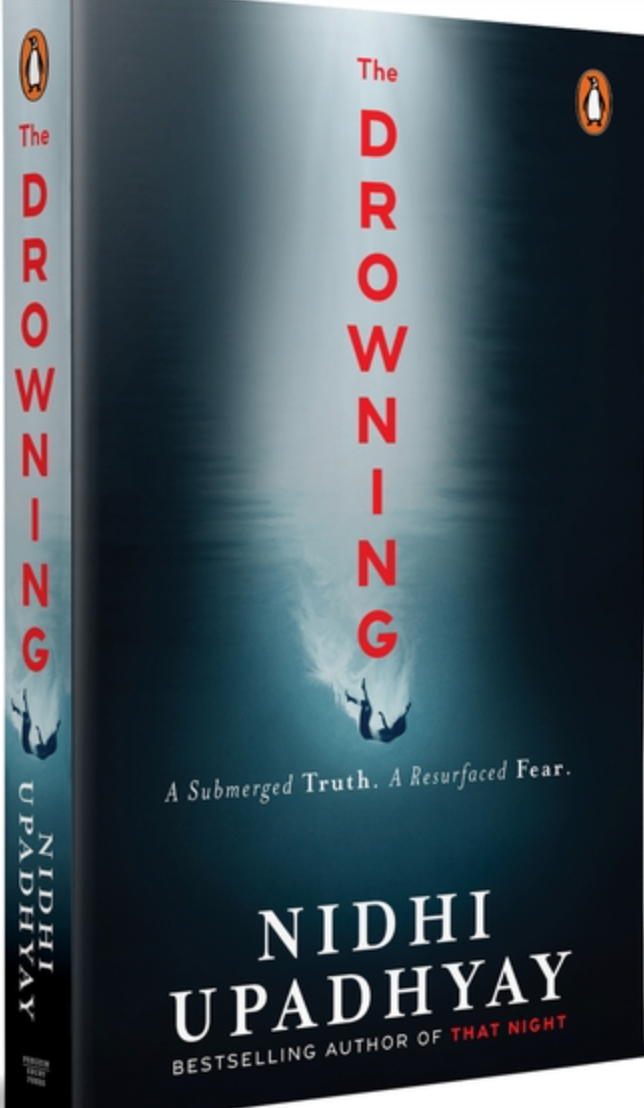
The Drowning
- Author Name:
Nidhi Upadhyay
- Book Type:

- Description:
Shattered by the loss of her twins, software engineer Viji becomes the prime suspect in a chilling crime—the drowning of her best friend Neha’s baby. ASP Kanika, haunted by her own personal loss, is pulled into an investigation that quickly spirals into a nightmarish descent. Viji’s eerie silence only deepens the enigma, and as Kanika digs further, her instincts sense something far more sinister lurking beneath the surface. The evidence hints at Viji’s involvement in black magic to resurrect her twins, but the scene defies logic. Viji is found in a trance, cradling the lifeless baby, while Neha has vanished without a trace. Neha isn’t alone; in the past week, four pregnant women have disappeared, each leaving behind a blood-streaked symbol—an ominous mark of doom. When Neha’s mutilated body is discovered, branded with the same grotesque symbol, Kanika realizes she’s up against something much more terrifying than a serial killer. As she unravels a web of evil tantric practices, Kanika confronts a horrifying possibility: Is she hunting a twisted killer, or has she awakened an ancient, malevolent force? And if so, how long before it comes for her?
Maya's New Husband 2: The Birth of the Death
- Author Name:
Neil D' Silva
- Book Type:
- Description:
In the suburbs of Mumbai, the atmosphere is grim. There is an evil shadow lurking around, stalking and snatching away able-bodied people. The hapless victims are never found again, their bodily traces lost forever. Embroiled in this is Maya Bhargava, a schoolteacher trying to forget a past personal tragedy. Focusing on her promising career, she is learning to pick the broken pieces of her heart and move on. While still trying to cope, love comes her way. It comes from the most unexpected of quarters, from a man named Bhaskar Sadachari who is despised and feared for his weird ways. The sensible and cautious Maya has her head in the right place, but it is her heart that refuses to obey. She chooses her new husband. And then the horrors begin to unfold.

Maya's New Husband
- Author Name:
Neil D' Silva
- Book Type:
- Description:
In the suburbs of Mumbai, the atmosphere is grim. There is an evil shadow lurking around, stalking and snatching away able-bodied people. The hapless victims are never found again, their bodily traces lost forever. Embroiled in this is Maya Bhargava, a schoolteacher trying to forget a past personal tragedy. Focusing on her promising career, she is learning to pick the broken pieces of her heart and move on. While still trying to cope, love comes her way. It comes from the most unexpected of quarters, from a man named Bhaskar Sadachari who is despised and feared for his weird ways. The sensible and cautious Maya has her head in the right place, but it is her heart that refuses to obey. She chooses her new husband. And then the horrors begin to unfold.

The Canterville Ghost
- Author Name:
Oscar Wilde
- Book Type:
- Description:
There has been a ghost in the house for three hundred years, and Lord Canterville's family have had enough of it. So Lord Canterville sells his grand old house to an American family. Mr Hiram B. Otis is happy to buy the house and the ghost - because of course Americans don't believe in ghosts. The Canterville ghost has great plans to frighten the life out of the Otis family. But Americans don't frighten easily - especially not two noisy little boys - and the poor ghost has a few surprises waiting for him.

The One Legged
- Author Name:
Sakyajit Bhattacharya
- Book Type:
- Description:
When the moldy wall of the old mansion began to heave and the shadows of the cursed tree ruffled his nights, Tunu learned how darkness lives not only at night– that the home itself is like a sleeping giant, shrouded in secrets, grief and loss. As the receding history repeated itself, Tunu turned slowly, but definitely, into someone else. Into something else.

Horror Stories
- Author Name:
Ambrose Bierce +1
- Book Type:
- Description:
The book "Horror Stories" features a collection of some of the most famous horror stories by notable authors such as Edgar Allan Poe, Ambrose Bierce, Bram Stoker, E. F. Benson, Algernon Blackwood, Saki, William Hope Hodgson, Lord Dunsany, H.P. Lovecraft, and C. P. Hartley. Each author presents a unique and chilling story that explores the horror genre's themes such as the supernatural, the macabre, and the unexplained. The book takes readers on a journey through different eras of literature and the evolution of the horror genre, from Poe's classic gothic tales to Lovecraft's cosmic horror stories. The stories within the book range from classic ghost stories and tales of the unknown to more contemporary psychological horror. These stories are known for their ability to elicit a strong emotional response from the reader and create a sense of unease and terror. "Horror Stories" is a must-read for any horror enthusiast, providing an engaging and spine-tingling reading experience that will leave readers on the edge of their seats. Classic Horror stories were written by some masters of this genre. Edgar Allan Poe Ambrose Bierce Bram Stoker E. F. Benson Algernon Blackwood Saki William Hope Hodgson Lord Dunsany H.P. Lovecraft C. P. Hartley

The Canterville Ghost
- Author Name:
Oscar Wilde
- Book Type:
- Description:
The Canterville Ghost is set in the English countryside in the late 19th century. Most of the story takes place in Canterville Chase, which is described as an old mansion with secret rooms and passageways, long corridors stained glass windows, and oak paneling. Pictures of long-dead Canterville ancestors, ancient tapestries, and a suit of armor add to the medieval-like setting. Overall, it seems to fit the stereotype of a haunted house. The book follows fairy tale conventions and Wilde introduces Virginia Otis, a fairy-tale type heroine. Otis must believe that there is a soul worth saving in the murderous and grisly Sir Simon. Her actions, however, lead to a happy ending. Otis marries a Duke and receives a casket of valuable jewels from the Ghost.

Dracula
- Author Name:
Bram Stoker
- Book Type:
- Description:
It is a timeless Gothic horror tale written in 1897 that suggests a struggle between modernity and science with religion and superstition. The story is that of a Transylvanian vampire who, using supernatural powers, makes his way to England and they're victimises innocent people to gain the blood on which he survives. Led by Dr. Abraham Van Helsing-an expert on "obscure diseases"- a small group of men and a woman are at last able to overpower and destroy Dracula. The story is told in epistolary format, as a series of letters, diary entries, newspaper articles, and ships' log entries, whose narrators are the novel's protagonists, and occasionally supplemented with newspaper clippings relating events not directly witnessed. Dracula, has inspired the creation of numerous theatrical, literary and film adaptations - among them are the 1931 film Dracula and 1922 film Nosferatu, starring that propelled the vampire myth to the forefront of popular culture.

Chandausi Junction
- Author Name:
Shankar Sahay
- Book Type:

- Description:
A collection of short-stories set in the 20th Century India for the 21st Century kids & a nostalgic walk, for their parents & grandparents. Although this book has been named after the city of Chandausi, it contains stories from various places like Rishikesh, Agra, Champaran, Tilhar, Sambhal, Kanpur, Banaras, Lucknow and many others. These are the short stories of a bygone era-a period when India had either not gained independence or had been independent for not more than 35 years. These are the tales of journeys-taken up from the early 20th century to the end of a millennium, from Shahjahanpur to Delhi, from Bijnor to Hyderabad, from Hathras to Sweden & Norway, from Lakshmi Talkies, Allahabad to Night Watchman, Bangalore, from Panki to USA, from Dehradun to Canada, from Chandausi to Australia and many others. We are sure in all these stories, you will be able to find at least one character, which reminds you of your own self-of what you are, were or always wanted to be. Let us know the character with whom you have been able to relate to the most. Happy reading. “Genius is one percent inspiration and 99 percent perspiration,”-Thomas A. Edison. -Here’s a collection of short stories to inspire the readers.

Case Files of The Dead
- Author Name:
Various Authors
- Book Type:
- Description:
Welcome to a mysterious land where ghosts. Ghouls and spirits rule. Welcome to a place where haunted houses and evil souls will make a shiver run down your spine. A spooky tale in the scenic hills of Mussoorie awaits you while uncanny happenings in a literary competition are sure to intrigue you. The case of a mysterious white Maruti baffles everyone, even as the unsuspecting jogger experiences something he had never bargained for. A group of friends will encounter the worst terror of their lives while nightmares of his death rack the young man! Author's In and The Book Bakers present an eclectic mix of true stories, legends, and fables that have often been a part of India's folklore—armed with some of the best authors in India's paranormal literature history. CASE FILES OF THE DEAD; India's first pure horror public anthology will turn every host into (G)Host!!!

Where Love Was Sinful
- Author Name:
Chirasree Bose
- Book Type:

- Description:
A tangled love on the battlefield of sinners… Maya: I’ve arrived in Delhi to meet my husband’s family after six months of our wedding. But what should have been a celebration turns catastrophic and people begin to die. Has it got anything to do with my secret? Shaaman: I love my wife, Maya, and God knows I have tried to be what she likes. But as I step into this house, my maternal grandfather’s house, I can feel the demon in me waking. I need help. But…what if it’s too late? Aahil: Maya. She always called me a mystery. And so I am. The mystery that started it all. The mystery that will end it all. Sparing none, not even her. Witness the most gruesome game of love, greed, revenge, power, betrayal, and hate in a tale full of sinners, a tale where love was sinful.

The Power of Your Subconscious Mind
- Author Name:
Dr. Joseph Murphy
- Book Type:
- Description:
The Power of Your Subconscious Mind, one of the most popular bestselling inspirational guides of all time, shows how changing your thought patterns can produce dramatic improvements in your life. Using practical, easy-to-understand techniques and real-world case studies, Dr Joseph Murphy reveals the vast influences of the subconscious mind on all aspects of existence-money, relationships, jobs, and happiness and how you can apply and direct its power to achieve your goals and dreams. Through this book, DDrMurphy provides the readers with the tools that one would need to unlock the extraordinary powers of their subconscious mind. One can improve relationships, finances, and physical well-being by following it. Once a person has learned how to use this unbelievably powerful force, there is nothing they will not be able to accomplish.

Unjudging Women
- Author Name:
Rachna Chaudhary
- Book Type:
- Description:
This book is based on a critical feminist reading of selected Delhi High Court judgements pronounced in the 1990s. It focuses on the phenomenon of female criminality and the pervasiveness of the disciplinary powers of law in our lives. Through an overview of existing studies on female crime in India and the interaction with the working) of the law and the legal system, This engagement pushes our understanding of law from an instrument of control and mode of social transformation to mere rhetoric. Not to argue for the futility of engaging with the law but emphasising the need to look at it closely and critically.

Mathematics Wizard Srinivasa Ramanujan
- Author Name:
Narendra Govil +1
- Book Type:
- Description:
Mathematics Wizard Srinivasa Ramanujan The book depicts the interesting story of a mysterious Indian mathematician, Srinivasa Ramanujan, with no college education, whose mathematics in a series of letters to a Cambridge Mathematician, G.H. Hardy, shook the entire mathematics community. It is an exciting journey of a poor, self-taught and god-gifted mathematician who by the age of 31 became the youngest Fellow of Royal Society of London. Even after almost 100 years of his death at the age of 32, his results mysteriously find applications in modern world such as in the study of black holes, quantum gravity, cryptography and many others. Ramanujan’s life story and work has inspired numerous people and generations of mathematicians around the globe and continue to excite even today. We hope that the book will reach the current generation and generate interest in mathematics.

An Alternative Perspective On Education
- Author Name:
Atul Kothari
- Book Type:
- Description:
Education is the foundation of the development of any country. But in our country, the First Education Policy was framed in 1968, 21 years after independence; the second policy was formulated in 1986; 34 years later, India got the National Educational Policy-2020 on 25th July, 2020. Besides these, certain commissions were also constituted for reforms in education, which made some good recommendations, but these could not be implemented for sheer want of political will. For an instance, the Kothari Commission in 1968, recommended 6 per cent of Gross Domestic Product (GDP) for expenditure on education, which was also adopted by the Education Policy-1986, but this is yet to be translated into practice. If we ignore pre-colonial period, the Bharat of post-independence has not yet been able to determine the aim of education. Character building and moulding a human i.e. holistic development of personality should be the aim of education. Essays on related subjects are included in this book. To identify the issues and problems that plague the education, and their solution, we carried out basic but innovative experiments in schools, colleges and universities. The original experiences of these exercises have been penned down as articles and research papers. This book is an anthology of the related writings.

Child Health And Nutrition In India
- Author Name:
Sanjay Prasad +2
- Book Type:
- Description:
This book is an attempt to present, in a consolidated form of research articles that can provide a common platform for communication and discussion about healthcare and service providers, functionaries, scholars and social workers involved with child health and nutrition. The scope of this book is to present an overview of child health, maternal health and community issues in India and also attempt to highlight some of the important issues in this field.

The Road to Infinity
- Author Name:
Tanbir Dhingra
- Book Type:
- Description:
"A Self-Exploratory Odyssey to ‘Infinity’ and ‘Beyond’ with Infinite Thoughts encapsulating Infinite Emotions in Infinite Moments giving Infinite Chances to explore ‘Who You Are in the quest for ‘What Is life’. A magically crafted peregrination of quotations reveals a deep longing for a greater sense of meaning, happiness and contentment. It helps to create enchanting thoughts that incorporate the classic tools of transformation into a simple philosophy of living. This is not just another book that should find its way to the self-help shelf; rather it’s a coach to motivate you and a best friend to inspire you forever. The book teaches us wisdom to: Build a Life of Passion, Purpose and Peace Value Time as our most important commodity Stay Fit by creating healthy habits not restrictions Nourish our Relationships and value things we Love Cultivate innovation of Colors and creativity from Nature

Worlds First Book On Haiku Poetry
- Author Name:
Carlos Luis
- Book Type:
- Description:
Haiku is a very short form of Japanese poetry consisting of 17 syllables arranged in three lines of 5, 7, and 5 syllables respectively. But against all odds, this is a collection of feelings written in three lines. An economical masterpiece that Trades you through realities of life; speaking of love, relationships, paradoxes in life, you name it you have it in here.

The Scarecrow Chronicles
- Author Name:
Pathik Mitra
- Book Type:
- Description:
Look into the mirror of the sciety and all you see is a scarecrow!" An anthology that mirrors the society at large. Thirteen stories that take you to the streets of Kabul to the paddy fields in rural Bengal, from a chirstmas in Paris to a famine in Orissa, from the lavish life futility of a rockstar to the aspiring dreams of a prostitute from artistic nudity to meeting God. This anthology has it all. The roller coaster ride of emotions will justify life is nor black , nor white but mostly grey!! And the scarecrow in some paddy field will keep mocking the society and it's futile taboos!! Can we be the scarecrow? An anthology you may love or hate but can't ignore for sure!!

Musings of A Psychologist
- Author Name:
Dr. Gauri Nadkarni Choudhary
- Book Type:
- Description:
The scope of psychology is beyond the clinic. It is in everything that we do and we don't do. The articles are just a different perspective of looking at everyday happenings and how they relate to how we deal with life.? Life doesn't come with an instruction manual. Often we shy away from talking about mental health or we confuse mental health with mental illness. These articles talk about simple day matters which have an impact on us. These are topics which we all face but don't realise that they have had an impact on us. It is a simpler way to look at things that bother us.

Customer Reviews
Be the first to write a review...
Shakchunni by Arnab Ray fuses Bengali folklore with the stark realities of the Great Famine of Bengal, setting a Gothic horror tale against the backdrop of one of India's darkest historical moments. The narrative centers on the Banerjee zamindari of Shyamlapur, where Narayanpratap—a London-educated poet who returns home nursing a broken heart—is married to the ethereally beautiful Soudamini. On their wedding day, a tantrik delivers an ominous warning: 'The Shakchunni dances tonight.' The demon of Bengali lore, known for possessing married women, awakens amid the family's complacency and the countryside's starvation. Ray's visceral prose contrasts the opulence of the zamindari estate with famine-ravaged Bengal, weaving a narrative that is as much about human greed and moral decay as it is about supernatural terror. Readers encounter a cast that includes the Raibahadur, his boisterous younger son Rudrapratap, and Superintendent Ramprasad Sinha, each driven by desires that prove fatal when the Shakchunni's reign of terror begins.
What kind of reading experience will Shakchunni give me?
Shakchunni delivers a visceral, atmospheric horror experience anchored in historical dread rather than jump scares. The prose moves quickly—readers report finishing it in two days—yet the terror builds slowly, rooted in moral corruption, human greed, and the contrast between zamindari opulence and famine-era suffering. You'll feel the weight of dark secrets and an ominous folklore presence throughout, with moments of graphic violence that serve the narrative's emotional stakes. The book leaves behind a lingering unease about the darkness within human nature as much as the supernatural.
Who is Shakchunni best suited for, and what does it expect of its reader?
Shakchunni rewards readers who appreciate historical horror grounded in cultural specificity—those curious about Bengali folklore, the Great Famine's impact on rural society, or the fall of the zamindari system. It expects tolerance for graphic depictions of violence and an interest in character-driven horror where the terror emerges from human psychology as much as from the supernatural. Readers seeking authentic Indian Gothic atmospheres, richly drawn characters with morally complex arcs, and folklore treated with seriousness rather than spectacle will find this compelling. Prior knowledge of Bengali culture enriches the experience but isn't required.
What is the cultural significance of Shakchunni's subject to Indian readers today?
The Shakchunni—a demon who possesses married women in Bengali folklore—embodies anxieties about female autonomy, desire, and agency within patriarchal structures that remain resonant in contemporary India. Set during the Great Bengal Famine, the novel interrogates how power, caste privilege, and colonial exploitation create moral vacuums where both human and supernatural horrors thrive. For Indian readers, it reclaims folklore not as a quaint tradition but as a lens for examining class violence, the zamindari system's brutality, and the political turbulence surrounding independence—themes that echo in ongoing conversations about inequality and historical memory.
What makes Arnab Ray's treatment of folklore distinctive in Shakchunni?
Arnab Ray refuses to treat the Shakchunni as a mere supernatural spectacle; instead, he embeds the demon within a meticulously researched historical moment—the Great Bengal Famine—and uses it to expose the moral rot within the zamindari class. His prose is visceral and cinematic, depicting both the famine's devastation and the demon's violence with unflinching clarity. Ray balances plot-driven suspense with deep character exploration, particularly through Soudamini's transformation and the Banerjee family's layered complicity. The folklore becomes inseparable from the social critique, making the horror both culturally rooted and thematically resonant.
What does Shakchunni leave the reader with—emotionally, intellectually, or culturally—long after they finish it?
Shakchunni lingers as a meditation on how greed, unchecked power, and moral complacency invite their own forms of reckoning—whether human or supernatural. Emotionally, readers carry the weight of its visceral violence and the tragedy of characters trapped by their desires and societal roles. Intellectually, it prompts reflection on the interplay between folklore and historical trauma, particularly how the horrors of the Great Famine intersect with the supernatural to reveal deeper truths about colonial-era Bengal. Culturally, it reclaims Indian Gothic as a space for serious literary exploration, proving that folklore can bear the weight of both historical witness and psychological complexity.