Sheela's Two Homes
About the book
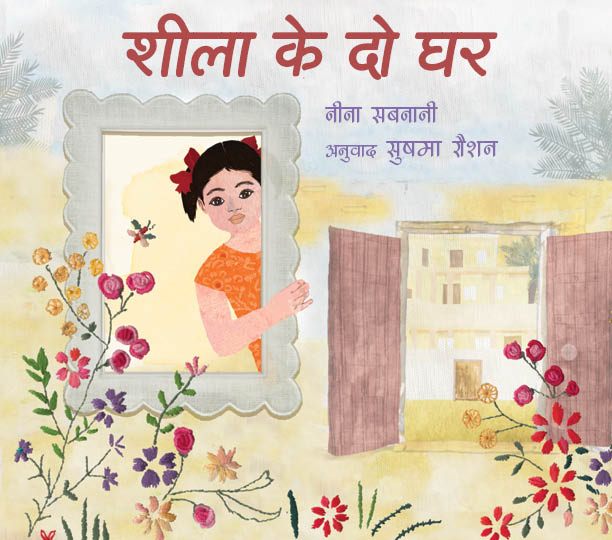
Sheela is any happy child growing up in Sukkur, Sind – playing with friends, sewing dresses for her dolls... She lives with her uncle whom she calls Baba, father, just across the road from her real parents. The turbulent times in the run up to Independence don’t touch her. Till suddenly, there’s Partition. The gentle unfolding softens realities of a childhood quite far removed from today’s readers. Springing from yet another animation film by Nina Sabnani, it is her mother’s own story, and she continues that connection with the choice of visuals – fragments of cloth, touches of embroidery, that tell of a life across two countries, with two fathers, in two homes.
Read more₹
250
₹ 207.5 17% off
Available
Format
About the Book
Sheela is any happy child growing up in Sukkur, Sind – playing with friends, sewing dresses for her dolls... She lives with her uncle whom she calls Baba, father, just across the road from her real parents. The turbulent times in the run up to Independence don’t touch her. Till suddenly, there’s Partition.
The gentle unfolding softens realities of a childhood quite far removed from today’s readers. Springing from yet another animation film by Nina Sabnani, it is her mother’s own story, and she continues that connection with the choice of visuals – fragments of cloth, touches of embroidery, that tell of a life across two countries, with two fathers, in two homes.
Book details
- Format
- Paperback
- Publisher
- Tulika Publishers
- Weight
- 120 grams
- ISBN-13
- 9789349993259
- Pages
- 40
- Reading time
- ~1 hrs
- Age
- 7-11
- Country of origin
- IN
- Dimensions
- 20 × 20 cm
- Language
- English
Sheela Ke Do Ghar
- Author Name:
Nina Sabnani
- Book Type:

- Description:
Sheela is any happy child growing up in Sukkur, Sind – playing with friends, sewing dresses for her dolls... She lives with her uncle whom she calls Baba, father, just across the road from her real parents. The turbulent times in the run up to Independence don’t touch her. Till suddenly, there’s Partition. The gentle unfolding softens realities of a childhood quite far removed from today’s readers. Springing from yet another animation film by Nina Sabnani, it is her mother’s own story, and she continues that connection with the choice of visuals – fragments of cloth, touches of embroidery, that tell of a life across two countries, with two fathers, in two homes.
Ismat's Eid
- Author Name:
Fawzia Gilani Williams
- Book Type:
- Description:
Ismat the shoemaker decides to buy his family special gifts for Eid. He is persuaded by the shopkeeper to buy a pair of trousers for himself. However, there is only one last pair and it's too long. But long trousers can always be shortened, can't they? Eid arrives, and with it comes a shock and a surprise. This crisp adaptation of a delightful Turkish tale has been affectionately told and illustrated, replete with cultural resonances.

Who Clicked That Pic
- Author Name:
Nandita da Cunha +1
- Book Type:
- Description:
नंदिता की कहानी भारत के सबसे प्रसिद्ध फोटोग्राफर, होमाई व्यारवाला के जीवन का जश्न मनाती है। होमाई का साहस और शिल्प कौशल पुस्तक में खूबसूरती से सामने आता है। प्रिया कुरियन के चित्रण होमाई की कार्यशैली को इतनी सटीकता से बनाए रखते हैं कि कभी-कभी ऐसा लगता है मानो होमाई ने ही पुस्तक का चित्रण किया हो। शिल्प और जीवन के बीच निरंतर बदलाव पाठकों को रंगमंच की जीवंतता की याद दिलाता है। किताब हिंदी और अंग्रेजी दोनों भाषाओं में उपलब्ध है।

Cobalt Blue
- Author Name:
Students of DPS
- Book Type:
- Description:
A collection of short stories written by students at DPS

AMMACHI'S GLASSES
- Author Name:
Priya Kuriyan
- Book Type:
- Description:
Ammachi can’t find her glasses one morning and everything goes topsy-turvy! Page after page spills with drama, humour, detail and local flavour as Priya Kuriyan spins a hilarious tale about a crazy day with unforgettable Ammachi — “the archetypal grandmother from memories of my own childhood in Kerala,” as Priya says. The celebrated illustrator is at her best in her first wordless picture book.

Barefoot Husain
- Author Name:
Anjali Raghbeer
- Book Type:
- Description:
When M.F. Husain loses his shoes, Jai offers to help find them. The two zoom in and out of his paintings, passing milestones in the artist's life

Will Goondi Come Home?
- Author Name:
Adithi Rao
- Book Type:
- Description:
Muthu’s constant companion is a rooster called Goondi. But her grandfather tells her not to get too attached to Goondi, since he belongs to Selvi Paati. And the village head wants to buy him for his son’s wedding feast… Muthu can’t bear the thought! So, she makes her move and Thatha makes his, in this tender story about what a dear friend is worth. Pictures add richness and depth to this layered narrative set in an Irula fishing village in Tamil Nadu. Their varying tones and textures capture the setting, the people and the moments.

Choomantar
- Author Name:
Geeta Dharmarajan +1
- Book Type:
- Description:
Jivuba wants to become a singer but she cannot because she has to get married. Luckily, Dammu, the wise apsara of the forest, casts a spell to remedy the situation! But what happens when the spell breaks?

Bishnu The Dhobi Singer
- Author Name:
Subhadra Sen Gupta
- Book Type:
- Description:
Details awaited

Bombay Ducks, Bombay Docks
- Author Name:
Fleur D’Souza +1
- Book Type:
- Description:
It is raining and there is not much one can do outdoors. Come and listen to Aajis story about the Kolis, the original inhabitants of Bombay, their favourite fish Bombay Duck and the citys magnificent docks.Written by Fleur D’Souza and Illustrated by Kripa.

India Through People: 25 Gamechangers
- Author Name:
Devika Cariapa
- Book Type:
- Description:
What does it take for a person to alter the course of a nation? Spotlighting 25 such change-making individuals, the book looks at the times in which they lived, the challenges they dealt with, and the paths they forged. Quick introductions position personalities as game changers, chatty stories sketch their profiles, crisp timelines fill in the gaps, insightful quotations balance perspectives, and creative collages present visual montages. What emerges is the powerful journey of a country at the threshold of change, committed to charting its own course, helmed by its richest resource – its people. Age 10+

Chintu Loses a Continent
- Author Name:
Vrinda Baliga
- Book Type:
- Description:
It’s Monday morning. Time for school. And his model of the earth…? Chintu Chitnis suddenly remembers he hasn’t made it! There’s a last-minute scramble to finish the project, with his little sister Pihu pitching in not very helpfully. And then, in school, Chintu finds an entire continent missing! Where did it go? Set in a Konkani household, this light and humorous story with playful pictures is a quick first introduction to the continents of the world.

Days With Thathu
- Author Name:
Geeta Dharmarajan +1
- Book Type:
- Description:
A magically beautiful story about Malar and her grandfather. A laptime, bedtime, anytime story for you to share. Enjoy! A beginnerís book for children learning to read.

Fakruddin's Fridge
- Author Name:
Meenu Thomas
- Book Type:
- Description:
When Fakruddin worries, he gets frantic. And Frantic Fakru is now worried because his fridge is spoilt, the day is hot, and he is desperate for cold water. What does he do? A light-hearted story with a smart idea and cheerful watercolour illustrations which bring alive the ambience of Fakru's neighbourhood in Bhopal.

Abba's Day
- Author Name:
Sunaina Ali +1
- Book Type:
- Description:
Ayeshaís favourite day is Sunday, for itís her Abbaís day. Come, letís find out what happens at Ayeshaís home every Sunday and what makes it so special!

BUMONI'S BANANA TREES
- Author Name:
Mita Bordoloi
- Book Type:
- Description:
Bumoni’s big backyard, just outside the Kaziranga National Park, is bursting with banana trees. Then one night a herd of wild elephants crosses the river, discovers the trees, and gorges on them. Bumoni’s family is very upset – how do they keep the elephants away? Bumoni has an idea! But then, what will the elephants eat now? Spare but dramatic pictures create mood and atmosphere in this affectionately told story, set in Assam, of a family’s sustainable relationship with the environment – and elephants!

Go Go Flamingo
- Author Name:
Priya Kuriyan +1
- Book Type:
- Description:
A flock of flamingos flies south in search of food and drink. What they find in the water causes a hullabaloo… They get draped and decked in unspooled tape, rubber tyres, shoes, plastic bags, syringe-needles, even rear-view mirrors! Unaware of their doom, they break into a dance in a confused trance. Priya Kuriyan brings the irony alive through stunning visuals. Real objects imaginatively placed together with her drawings create a lifelike three-dimensional effect. Along with Devashish Makhija’s brilliant verse soaked in satire, they paint a telling picture – of the violence unthinking humans inflict on the natural world through hazardous waste.

Secret Wild Vet Kalyani
- Author Name:
Geeta Dharmarajan +1
- Book Type:
- Description:
Secret Wild Vet Kalyani is a book inspired by N Kalyani, Tamil Nadu’s first woman veterinarian who graduated from Madras Veterinary College in 1952, challenging gender norms within the profession. Through a cheerful poem set in the Nilgiri hills, the author and Katha’s Founder President Geeta Dharmarajan imagines her Irular protagonist as a kind of superwoman who helps rescue animals, birds and reptiles in danger. Filled with everything from guns to ropes and jungle antics, this adventure story truly comes alive with the help of lively illustrations by designer Boski Jain. According to the book, the DNA analysis (2018) of a skeleton from the Indus Valley Civilisation found in Rakhigarhi showed greater affinity with the Irula people than any other ethnic group in India. “A study by Yelmen et al (2019) found that the Irula were the closest likely proxy for the indigenous “AASI”, or Ancient Ancestral South Indian, one of the presumed founders and autochthonous original populations,” informs the book.

MAYIL WILL NOT BE QUIET
- Author Name:
Niveditha Subramaniam +1
- Book Type:
- Description:
Introducing Mayil Ganeshan, a lively 12-year-old who finally has the opportunity to express herself fully in her diary. This is a significant step towards achieving her goal of becoming a writer, as she hopes to make up for all the unfinished stories and the aimless novel she had written before. In her diary, Mayil shares a spontaneous, sensitive, honest, intimate, and often humorous account of her life and thoughts as a perceptive young girl going through the ups and downs of adolescence. This coming-of-age book is a must-read, with enough humor, heart, and wisdom to entertain and inspire readers of all ages. Age 10+

Gajapati Kulapati
- Author Name:
Ashok Rajagopalan
- Book Type:
- Description:
Small noses catch small colds. Big noses catch big colds. Gajapati Kulapati the elephant has a big nose and catches a great, big, mighty cold! And what happens when he sneezes – Aaaaachoooo….? With repetitive sounds and words that roll rhythmically through the pages, this bestselling series about the adorable elephant puts the zing back into storytelling and reading aloud. Bright, zestful pictures and dynamic visual text echo the lilt, making these big, happy books of fun.

Frequently asked questions
Delivery, payment and returns for this book.
<p><strong>Sheela's Two Homes</strong> offers a quiet, reflective reading experience that invites contemplation rather than dramatic tension. The book moves at the pace of childhood memory—unhurried, selective, focused on textures and small rituals like sewing doll dresses rather than political upheaval. <em>Nina Sabnani</em> uses restraint to honor her mother's story, leaving space for young readers to absorb the weight of dislocation without overwhelming them. It is a book that rewards slow reading and conversation afterward, lingering in what is unspoken as much as what is told.</p>
<p>This picture book is best suited for readers aged 6 to 10 who are ready to encounter historical complexity through personal narrative, as well as parents and educators looking for age-appropriate entry points into <em>Partition history</em>. It expects readers to be comfortable with ambiguity and to bring empathy to Sheela's confusion. <em>Young readers</em> with immigrant family histories or experience of displacement may find particular resonance here, though the book's emotional accessibility opens it to anyone curious about how children navigate upheaval they do not fully understand.</p>
<p><em>Partition</em> remains a defining rupture in South Asian memory, yet many children's books shy away from its intimate costs. <strong>Sheela's Two Homes</strong> fills that gap by centering a child's lived experience of <em>1947</em> rather than the geopolitical narrative. For Indian readers today, the book offers a way to talk with children about migration, belonging, and the arbitrary nature of borders—themes that resonate in a nation still shaped by those divisions. It honors personal memory as a form of historical witness, particularly important as the generation who lived Partition grows smaller.</p>
<p><em>Nina Sabnani</em> brings the intimacy of family testimony and the visual language of her animation work to a subject often told through adult retrospection. Because this is her mother's own story, the book avoids both sentimentality and didacticism, instead offering <strong>fragmented, sensory details</strong>—a girl's unusual living arrangement, the sudden absence of friends, the unspoken reasons for departure. Sabnani's choice to adapt her <em>animation film</em> into a picture book preserves the medium's capacity for suggestion and restraint, trusting young readers to meet the story halfway rather than explaining everything for them.</p>
<ul><li>A child's-eye understanding of how history interrupts the everyday, making familiar places suddenly foreign</li><li>An appreciation for family memory as a form of historical preservation, especially stories passed from grandparents to grandchildren</li><li>Questions about what <em>home</em> means when borders divide it, and how we carry lost places within us</li><li>Empathy for children navigating adult decisions they cannot control, whether in <em>1947</em> or today</li><li>A quiet recognition that some losses—dolls, streets, the freedom to live across the road—are both small and immeasurable</li></ul>
Customer reviews
Be the first to write a review
Read this one? Tell other readers what you thought about the story, the translation and the print.
Sheela's Two Homes brings the lived reality of the 1947 Partition into a child's frame, told through the eyes of a girl in Sukkur, Sindh, whose unusual family arrangement—living with her uncle across the road from her parents—becomes suddenly fragile when borders are drawn. Nina Sabnani, a Rajat Kamal Award recipient known for blending animation and personal history, adapts her mother's own childhood into a picture book that privileges emotional truth over dramatic spectacle. The gentle unfolding asks young readers to understand displacement not as a history lesson but as the loss of everyday certainties: dolls left behind, streets that empty, a home that becomes two countries.
What makes this work distinctive is its refusal to explain everything. Sheela's confusion—why turbulent times suddenly matter, why her two homes can no longer both be hers—mirrors the bewilderment children today feel when adult decisions reshape their worlds. The book is both a Partition narrative and a meditation on what childhood remembers when history intrudes.
What kind of reading experience will Sheela's Two Homes give me?
Sheela's Two Homes offers a quiet, reflective reading experience that invites contemplation rather than dramatic tension. The book moves at the pace of childhood memory—unhurried, selective, focused on textures and small rituals like sewing doll dresses rather than political upheaval. Nina Sabnani uses restraint to honour her mother's story, leaving space for young readers to absorb the weight of dislocation without overwhelming them. It is a book that rewards slow reading and conversation afterwards, lingering in what is unspoken as much as what is told.
Who is Sheela's Two Homes best suited for, and what does it expect of its reader?
This picture book is best suited for readers aged 6 to 10 who are ready to encounter historical complexity through personal narrative, as well as for parents and educators seeking age-appropriate entry points into Partition history. It expects readers to be comfortable with ambiguity and to bring empathy to Sheela's confusion. Young readers with immigrant family histories or experience of displacement may find particular resonance here, though the book's emotional accessibility opens it to anyone curious about how children navigate upheaval they do not fully understand.
What is the cultural or historical significance of Sheela's Two Homes for Indian readers today?
Partition remains a defining rupture in South Asian memory, yet many children's books shy away from its intimate costs. Sheela's Two Homes fills that gap by centring a child's lived experience of 1947 rather than the geopolitical narrative. For Indian readers today, the book offers a way to talk with children about migration, belonging, and the arbitrary nature of borders—themes that resonate in a nation still shaped by those divisions. It honours personal memory as a form of historical witness, particularly important as the generation that lived through Partition grows smaller.
What makes Nina Sabnani's treatment of Partition distinctive in Sheela's Two Homes?
Nina Sabnani brings the intimacy of family testimony and the visual language of her animation work to a subject often told through adult retrospection. Because this is her mother's own story, the book avoids both sentimentality and didacticism, instead offering fragmented, sensory details—a girl's unusual living arrangement, the sudden absence of friends, the unspoken reasons for departure. Sabnani's choice to adapt her animation film into a picture book preserves the medium's capacity for suggestion and restraint, trusting young readers to meet the story halfway rather than explaining everything for them.
What does Sheela's Two Homes leave the reader with long after they finish it?
- A child's-eye understanding of how history interrupts the everyday, making familiar places suddenly foreign
- An appreciation for family memory as a form of historical preservation, especially stories passed from grandparents to grandchildren
- Questions about what home means when borders divide it, and how we carry lost places within us
- Empathy for children navigating adult decisions they cannot control, whether in 1947 or today
- A quiet recognition that some losses—dolls, streets, the freedom to live across the road—are both small and immeasurable