
Borrowed Genius or Strategic Shortcut?
January 19, 2026
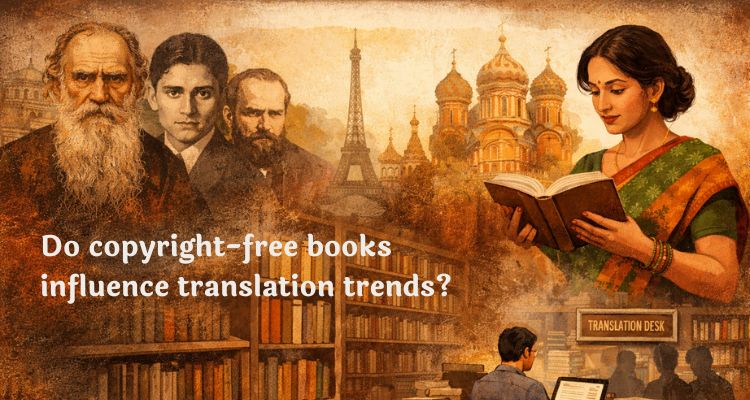
Why are foreign books translated so heavily into Indian languages?
They carry built-in recognition, lower copyright costs, and reduced financial risk for publishers.
Is translation easier than writing original Indian-language books?
No. Translation requires high literary skill, but it is easier for publishers to approve because the content is already validated.
Are Indian writers becoming less creative?
No. The issue lies in reduced editorial support, weaker discovery systems, and risk-averse publishing structures.
Are translated classics relevant to today’s Indian readers?
Partially. Universal themes resonate, but they cannot fully address contemporary Indian realities like caste, digital life, and regional identity.
Is publishing translations harming Indian literature?
Not inherently, but overdependence on translations limits the growth of modern Indian-language classics.
Walk into any Indian-language bookstore today, physical or digital, and you’ll notice a pattern. Tolstoy in Hindi. Dostoevsky in Marathi. Kafka in Malayalam. García Márquez in Bengali. New covers, old names, familiar foreign gravitas.
This isn’t accidental. It’s a structural choice the Indian publishing ecosystem has been making, quietly but consistently, for years.
Let’s break it down, without romance, without panic, and without blaming writers or publishers too easily.
The First, Uncomfortable Truth: Translations Are Safer
From a publisher’s desk, translations, especially of well-known foreign authors, are predictable products.
When you publish Leo Tolstoy, Fyodor Dostoevsky, or Franz Kafka, you’re not selling a story; you’re selling recognition.
The author’s reputation does half the marketing. Libraries buy them. Universities prescribe them. Reviewers take them seriously by default.
A new Indian-language novel, no matter how sharp, has to fight for every inch of attention.
This isn’t laziness. It’s risk management.
Copyright: The Quiet Backbone of the Boom
A large chunk of foreign classics being translated today falls under the public domain. No advances. No royalty negotiations. No legal back-and-forth across borders.
From a balance-sheet perspective, this is gold.
A publisher pays for:
- Translation
- Editing
- Design
- Printing
That’s it.
Compare this to commissioning an original work:
- Advance to the author
- Long editorial cycles
- Uncertain reception
- Slower sell-through
For small and mid-sized Indian publishers, especially in regional languages, the choice often isn’t philosophical. It’s economic.\
Is Translation “Easier” Than Writing Something New?
Technically? No.
A good translator is a writer with restraint. Translating Gabriel García Márquez into an Indian language isn’t mechanical labour; it’s cultural negotiation. Tone, rhythm, idiom, humour—everything can collapse if handled poorly.
But institutionally, translation is easier to greenlight.
The manuscript already exists.
The critical consensus already exists.
The risk is capped.
That’s the key difference.
The Lazy Accusation: “Indian Writers Aren’t Creative Anymore”
This line gets thrown around far too casually.
Indian writers are writing, constantly. Across Hindi, Tamil, Malayalam, Marathi, Assamese, Kannada, and Urdu. The problem isn’t creativity. It’s infrastructure.
- Fewer serious editors are willing to nurture raw manuscripts
- Declining literary magazines with real influence
- Shrinking review space in mainstream media
- Weak discoverability for new Indian-language voices
Meanwhile, translations arrive pre-validated.
The system rewards familiarity, not experimentation.
What About Reading Habits? Yes, They Matter.
Here’s the uncomfortable loop:
Indian-language readers increasingly consume:
- Translated foreign classics
- Translated contemporary global fiction
- Adapted mythological retellings
Original Indian-language fiction, especially contemporary, urban, political, or formally experimental, struggles to find sustained readership.
Writers read what circulates.
Publishers publish what sells.
The loop tightens.
This doesn’t kill creativity, but it redirects it.
Are These Translated Classics Relevant to Today’s India?
Sometimes, deeply so.
Alienation, power, poverty, bureaucracy, existential dread - these themes travel well. Kafka’s anxiety doesn’t feel foreign to a government office in Patna. Dostoevsky’s moral conflicts resonate in any society grappling with inequality.
But relevance has limits.
A 19th-century Russian aristocrat’s despair cannot fully speak to:
- Caste mobility
- Digital labour
- Climate displacement
- Tier-2 city aspirations
- Linguistic politics
Translations can sharpen literary taste, but they cannot replace lived narratives.
The Prestige Trap
There’s also a cultural bias at play.
Foreign literature, especially European, still carries disproportionate intellectual prestige in Indian academic and literary circles. A translated “classic” is seen as serious by default. An original Indian-language novel has to repeatedly prove its seriousness.
This bias trickles down, from syllabi to awards to bookstore curation.
What This Really Signals About Indian Publishing
The rise of translations does not signal a decline in Indian writing. It’s a mirror showing us where support systems are missing.
- Translation thrives where editorial risk is low
- Original writing thrives where institutions invest long-term
Right now, Indian-language publishing invests more confidently in the past, foreign or domestic, than in the present.
So, Is This Trend Good or Bad?
Neither. It’s incomplete.
Translations expand literary horizons. They train readers. They raise craft benchmarks.
But if they dominate the ecosystem, they flatten it.
A living language cannot survive on borrowed masterpieces alone.
The Question Publishers Need to Ask Now
Not why translations sell - we know that.
The real question is:
What conditions would make original Indian-language writing just as viable?
Until that question is addressed seriously, through funding, editorial mentorship, criticism, and reader engagement, translations will continue to lead the shelf.
Not because Indian writers lack imagination.
But because imagination, left unsupported, doesn’t scale.
Translations are not the problem. They’re a symptom.
A confident literary culture reads the world and writes itself back into it. Indian languages are halfway there.
The rest depends on whether the industry chooses safety or legacy.




Add a comment
Add a comment