
How Indian Fiction Surviving the Screen Age
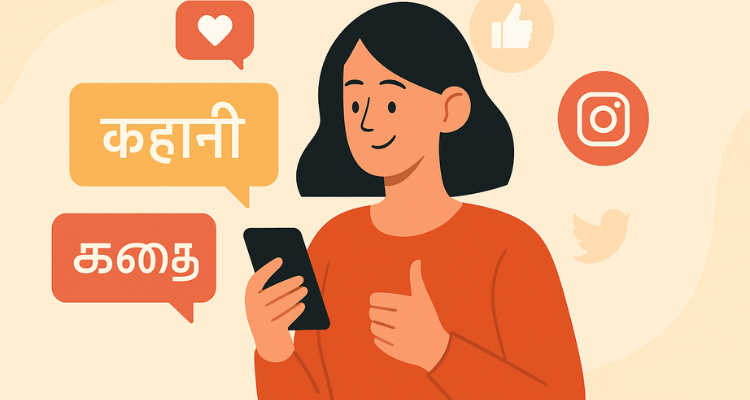
Ever imagined The Screen Ate the Story, or Did It? What happens when every story we used to read is now streaming on a screen?
Somewhere between a midnight binge-watch and an unfinished paperback lies the modern Indian reader, guilty, distracted, but still deeply in love with stories. In a country where the fireside once sang epics, we now scroll, skip intros, and consume narratives in 10-second reels. Yet, Indian fiction hasn’t disappeared; it’s evolved, silently adapting its rhythm to a world that watches faster than it reads.
Writers like Perumal Murugan, Manu Pillai, Anuja Chauhan, and Arundhati Subramaniam are proof that the novel isn’t dead; it’s simply learning to perform better in the age of streaming.
When Pages Became Playlists
OTT platforms like Netflix, Amazon Prime, Z5 and SonyLIV have quietly redefined how India tells and hears stories. Books that were once private experiences are now visual feasts. Consider Arundhati Subramaniam’s poetic narratives, though not directly adapted, her lyrical prose often feels cinematic, with its pauses, silences, and visual textures. Or Anuja Chauhan, the queen of rom-coms in Indian literature, whose Those Pricey Thakur Girls became a TV series (Dilli Wali Thakur Gurls) and whose Battle for Bittora is under adaptation with Sonam Kapoor’s production house.
Meanwhile, Manu Pillai writes history that reads like a Netflix documentary, with political scandal, royal intrigue, and personality-driven drama. His Rebel Sultans could sit comfortably next to Game of Thrones on your watchlist, and you wouldn’t notice the seam between archive and artistry.
And then there’s Perumal Murugan, whose raw rural realism, once too earthy for mainstream taste, has become the new cinematic aesthetic. His novels (Pyre, One Part Woman) feel tailor-made for slow, brooding screen storytelling, the kind that lingers, not rushes.
Why Writers Started Writing Like Directors
Indian fiction today feels edited for the eye. The paragraphs are shorter, the chapters end on cliffhangers, and the dialogue crackles with screenplay potential. The influence of visual media is undeniable.
When readers are used to fast cuts and emotional payoffs, writers have adapted by tightening narrative loops. Literary fiction is no longer just about interior monologues; it’s about pacing, rhythm, and “screenability.”
Lutyens’ Dilli by Abhik Bhanu - The novel is being adapted into a web series. The story centres on power, the media nexus, ambition, and resilience in Delhi’s political ecosystem.
Roohaniyat by Novoneel Chakraborty - It shows how romance-/youth-fiction is also getting adapted into streaming content (not just literary classics or heavyweight novels).
In essence, today’s writers are less like novelists and more like showrunners, balancing character arcs, episodic pacing, and visual hooks while still guarding the soul of literature.
Reading Is the New Watching (Just Slower)
But let’s not romanticise the binge. Not every story fits a screen. The intimacy of reading, that slow, solitary act, still offers something no series can replicate. When Amitav Ghosh builds the tidal world of The Hungry Tide, or Jhumpa Lahiri sketches human loneliness in a few lines, no camera can capture the breath between the words.
The novel survives because it still offers something streaming cannot - privacy. Reading remains the only way to experience a story that doesn’t need to trend.
The Indian Fiction Renaissance (and Its New Readers)
In fact, Indian fiction may be having its quietest yet most decisive moment. With platforms like Rachnaye, Storytel, and Amazon Kindle India, regional and contemporary writers have found ways to reach audiences who don’t have the time for bookstores but crave meaningful narratives.
You’ll find Geetanjali Shree’s Ret Samadhi (and its Booker-winning English translation, Tomb of Sand) being discussed on YouTube panels and Piyush Pandey’s reflections on ad-writing crossing over into literature podcasts. The lines are blurring - not just between books and screens, but also between reading and listening, literature and marketing, fiction and experience.
In Kerala, Tamil Nadu, and Bengal, publishing houses are even experimenting with “book trailers” and serialised e-fiction. As the attention economy shrinks, stories stretch into formats that catch it - short reads, digital anthologies, audiobooks, even AI-narrated fiction.
Indian literature, it turns out, has learned to hustle - without losing its heart.
The Screen Will Pass. The Story Won’t.
Netflix, Hotstar, and Prime will have their cycles - algorithms change, trends vanish, subscriptions lapse. But a well-told story? That’s forever.
When a generation raised on “Skip Intro” finally slows down to read a paragraph twice, something ancient stirs, that quiet joy of imagination unmediated by pixels.
So yes, we binge, we scroll, we fast-forward. But between one autoplay and the next, the novel still waits patiently, knowing that when the screen fades to black, we’ll return to words.









Add a comment
Add a comment