
Cash On Delivery
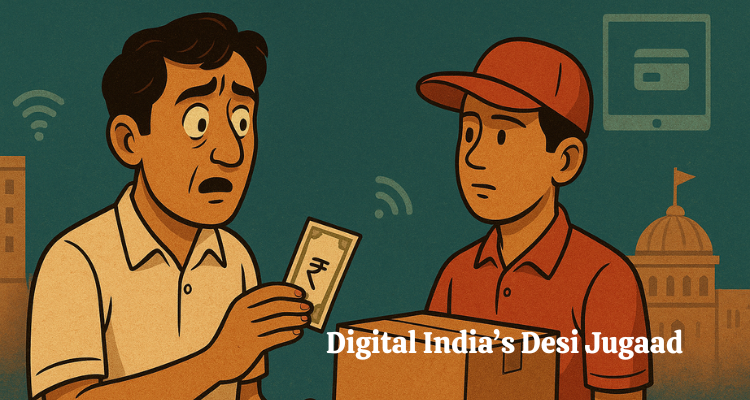
If there is one arena where India’s contradictions theatrically perform, it’s the intersection of books and Cash on Delivery.
In a country that worships knowledge, quotes the Gita, swears by Shakespeare in English exams, and treats books as auspicious gifts wrapped in golden paper, we still hesitate to… pay for them upfront.
And so, COD survives—no, thrives—like a stubborn appendix in the digestive tract of Indian e-commerce.
Cash on Delivery is our beloved financial safety blanket—sits there like a loyal Labrador, promising comfort in a world filled with OTPs, cyber frauds, vanished parcels, and customer-care robots who speak in oddly cheerful yet unhelpful tones.
Why do Indians prefer Cash on Delivery for books?
For starters, the Indian trust factor is a delicate creature. We are a civilisation that has learned—through myth, history, and the occasional WhatsApp forward—that things are not always what they seem. Horses turn into gateways, sages turn into monsters, and online sellers turn into “Sir, this item is not returnable.”
So, when an app tells us, “Sir, please pay ₹699 right now, and we promise your parcel will reach you in 7-10 business days,” there’s a primordial voice in our heads that whispers, “Pay later. Inspect first. Then decide.”
COD is not just a payment method. It is, in truth, a cultural expression.
- It reflects our national suspicion of anything that can disappear into the ether—data, money, or the neighbourhood electrician.
- It comforts us with a tactile exchange: item in hand, money in hand.
- It allows us to feel in control in a world where everything else—from trains to traffic lights—operates on divine whim.
And let’s be honest: COD also indulges our spontaneous decision-making, the kind that goes, “Arre, dekhte hain. Let me order it. If I don’t like it, I just won’t pick up the courier’s phone. Problem solved.”
We didn’t invent democracy, but COD has certainly brought democracy to our shopping choices.
The Indian Reader’s Paradox: Reverence for Books, Reluctance to Prepay
Here’s the thing: Indians adore books, but do not always trust the process of obtaining them. A peculiar mix of affection, suspicion, nostalgia, and stinginess thus governs online book buying.
We are a civilisation that once negotiated with raddi-walas over old textbooks with the intensity of diplomatic summits. So naturally, when an app asks for ₹349 upfront, we behave as though we’re signing over property rights.
Thus enters COD, our beloved security blanket, ensuring we pay only when the packet—ideally containing the correct book, and not a soap box or a brick—appears at our doorstep.
Why COD Persists in the Book Business (Even Though It Really Shouldn’t)
Let’s break it down.
Unlike electronics or fashion industries cushioned by plush margins, the book trade is more spartan. Booksellers often operate on margins so thin you could host a yoga retreat on them. Between printing, warehousing, distributor cuts, platform fees, and discounts demanded by customers who think ₹199 is an outrageous price for a 300-page masterpiece, there isn’t much left.
Now add COD operational chaos to that fragile financial ecosystem:
- Longer delivery cycles
- Higher return and cancellation rates
- Cash-handling risks
- Lost shipments
- The buyer insists on paying with a ₹2000 note for a ₹349 item.
- Someone’s grandmother asks for five minutes to “check the binding of the book"
- Customers who say “Main ghar pe nahi hoon, kal aa jana”
- and the ultimate tragedy: “Sir, maine toh order hi nahi kiya.” or “Bas, mann badal gaya.”
Every failed COD order is a tiny apocalypse for booksellers who already make less than the street vendor selling chaat outside the metro station. Behind the scenes, companies run reconciliation operations that resemble a cross between a CSI lab and a satsang—looking for “lost cash,” “partial payments,” “fake returns,” and occasionally, “the delivery guy who has vanished with the day’s collection.”
If Shakespeare were alive, he would’ve written a tragicomedy about COD. Something like Much Ado About Money That Was Never Ours To Begin With.
Yet, they can’t switch it off—because COD isn’t just a feature; it’s the emotional lubricant of Indian online shopping.
Remove it, and half the buyers vanish like library books never returned.
A Nation of Hesitant Bibliophiles
Indians don’t distrust books.
They distrust the possibility that the book won’t arrive, won’t look as promised, will have a torn corner, or—catastrophe of catastrophes—will be a pirated photocopy smelling faintly of chemical regret.
COD, therefore, becomes a literary checkpoint:
- Is the cover colour the same as the listing?
- Are all the pages intact?
- Is the printing legible and not a Rorschach test?
- Does it look “giftable” to cousins we meet once a year?
Only after these rituals is the cash bestowed upon the delivery person, who by this point has developed the patience of a monk.
Enter the Cyber Villains
As India becomes an all-you-can-eat buffet for cyber fraud, readers have grown wary.
Every day brings delightful digital horrors:
- “Your book is on hold; pay ₹29 to release it.”
- “Please verify your COD order of ₹1,999.” (You only bought a ₹175 novella.)
- Fake delivery calls asking for “confirmation charges.”
In this circus of inventive deception, COD feels like a shield.
Better to pay the human being with a bag than some phantom merchant in the cloud.
Of course, fraudsters have now taken to impersonating delivery agents too.
So we’re effectively stuck choosing between:
- digital scams,
- doorstep scams,
- or the eternal philosophical dilemma: to prepay or not to prepay.
The Delivery Agent: Scholar of Patience, Saint of Logistics
Picture this noble figure.
He rings the bell.
You open the door with the air of someone meeting a tax inspector.
He announces, “Book delivery, sir.”
You respond, “Bas ek minute,” and proceed to examine the parcel as though it contains state secrets.
He waits.
You fetch your wallet.
He waits.
You take forever to find the exact change.
He waits.
You finally pay.
He, in that moment, becomes the unsung hero of Indian reading culture.
Will COD Ever Die in the Book Trade?
Let’s not forget the sentimentality involved. For many older Indians, COD holds a simple charm: it feels like actual shopping. There’s the touch, the inspection, the feeling of control. UPI is magic; COD is familiarity.
For younger Indians, COD is a comfort buffer. A way to buy impulsively without fully committing. Like dating without defining the relationship.
And for millions in semi-urban and rural India, COD is access. Not everyone has a debit card. Not everyone trusts online banking. But everyone trusts physical cash and the promise of “If it doesn’t come, it doesn’t come.”
COD is democratic. Inclusive. Unruly. And very, very Indian.
Here’s the part that always fascinates me: COD is simultaneously a logistical nightmare and a cultural masterpiece. It brings together economics, psychology, chaos, and human warmth.
A delivery agent hands you a parcel.
You hand him cash.
No passwords. No phishing. No 16-digit card numbers.
Just two humans engaging in a transaction as old as markets themselves—yet wrapped in plastic and delivered by GPS.
It’s almost poetic.
And in this absurd, swirling, cybercrime-ridden, AI-powered digital bazaar we now inhabit, a little poetry is no bad thing.
Long story, short. Not anytime soon.
But it will evolve.
- UPI-on-delivery will grow.
- Lightning-fast refunds will soften prepaid fear.
- Trust in indie sellers (including platforms like Rachnaye, which champion transparent payments for writers and publishers) will eventually shift habits.
- Better awareness of cyber safety will reduce paranoia.
But let’s be real: Indians will abandon COD only when we collectively decide that books deserve less suspicion and more spontaneity.
Until then, our relationship with COD will remain—like a long-running chapter in a never-ending epic.










Awantika Singh
Dec 5, 2025
Nice one
Awantika Singh
Dec 5, 2025
Nice one
Add a comment
Add a comment