
Retelling Epics in a Time of Algorithms

In an age when our thumbs flick over reels and our attention hovers for seconds rather than chapters, something curious is happening in Indian literature and media: the great epics of South Asia are being remixed, reworked and retold.
The ancient war-story of Mahābhārata is no longer just the Sanskrit text recited in classrooms; it’s being retold for the TikTok generation, for readers who binge-scroll after they’ve scrolled past everything. Ever thought, why these epic retellings? And why now? What I’ll call New Mahābhāratās are flourishing in the algorithm era, carrying tensions from empowerment to critique, and from devotion to disruption.
Myth still matters
Myths endure because they tap into what humans have always grappled with: power, duty, identity, betrayal, family, and war. These eternal themes lend epics like the Rāmāyaṇa, Mahābhārata, or any similar story for that matter.. a kind of timelessness. Mythological stories are timeless… their teachings and context remain relevant irrespective of how far we travel in time across the past, present and future.
Why, among the digital generation, does this matter?
Attention spans + formats: The digital generation scrolls fast. But the epic offers chunks of drama (wars, dice games, exile, divine intervention) that can be re-packaged into micro-stories (short reels, tweets, threads).
Meta-narrative hunger: People in 2025 don’t just want “war”, they want perspective, voice, revision. Retellings offer new vantage points (the “villain”, the woman, the silent figure) that suit a plural, questioning readership.
Algorithms favour the familiar but novel: Social-media algorithms love recognisable brands (epics) + fresh twists (retellings). If you take Draupadī or Karṇa and re-imagine them, you have both brand-recognition and novelty.
Global-Indian diaspora & cross-boundary audiences: These stories travel; Hindi, English, regional languages, graphic novels, web-series. By repackaging epics, writers tap into diaspora identity, local-global hybridity and digital consumption patterns.
Why the epic still works in an AI age
The very complexity of the Mahābhārata, hundreds of characters, shifting loyalties, and moral ambiguity, lends itself to reinterpretation in an age of many voices. Scholars are using it even for NLP/AI work (e.g., “Estimating related words computationally using language model from the Mahabharata”), demonstrating that its depth engages computational thinking.
In a time of algorithmic feeds that emphasise surprise, the epic’s open-ended, layered structure (rooms for doubt, multiple perspectives) gives rich fodder for new authors and new audiences.
The motifs of war, dharma (duty/ethics), and fate vs. agency resonate strongly with digital natives navigating unpredictability in work, relationships, and identity.
What the retellers are doing
Let’s look at some concrete trends in how writers are retelling these epics and what that says about culture, algorithms and faith.
Changing the narrator, changing the story
Many contemporary retellings shift perspective: the heroine instead of the hero, the villain instead of the victor. For example:
Parva: The novel narrates the story of the Mahabharat mostly using monologue as a literary technique. Several principal characters found in the original Mahabharat reminisce about almost their entire lives. Both the setting and the context for the reminiscence are the onset of the Kurukshetra War. The novel begins with a conversation in the court of Madra Desh. It was the time when the preparations for war had just started. Reminiscences of Kunti, Draupadi, Bheem and Arjun follow the episode. The next part of the novel discusses the war from a rational view.
Draupadi: Draupadi, originally written in Telugu, was first serialised in Andhra Jyoti before it was published in book form. The novel is presented in a unique style and is not just an account of the various incidents occurring around Draupadi but also weaves these incidents into a fascinating story. The narrative technique and structural method of description used by Lakshmi Prasad fully engage the reader.
This reversal feeds into social‐media logic: we love “the other side”, “what they didn’t show us”, “the hidden story”. The algorithm rewards alternate viewpoints.
Feminist, Minority, Marginalised Voices
Retellings often spotlight women, lesser-known characters, and perspectives from caste/tribal communities. E.g., the book list noted in 2025’s “10 Indian Mythological Fiction Books You Must Read” emphasises Uruvī (in Karna’s story), Gāngā and Satyavatī (in a Mahābhārata prequel) as central voices.
This trend reflects cultural shifts: more authors want to recast mythology not as a monolithic divine story but as a human and social story, influenced by gender, class, and region.
Gritty, Revisionist, “Anti-Hero” Mytho-Fiction
Some retellings adopt the tone of modern fantasy/thriller: political intrigue, gritty realism, dark backstories. This is aimed at the binge-reading/streaming-era audience. E.g., one list notes: “The Aryavarta Chronicles (Govinda Trilogy) … reimagines the Mahabharata as a gritty political saga.”
So the epic becomes a brand, but authors spin it into forms that match digital-era tastes: faster pacing, multiple POVs, ambiguous morals.
Cross-Media, Short-Form, Viral Potential
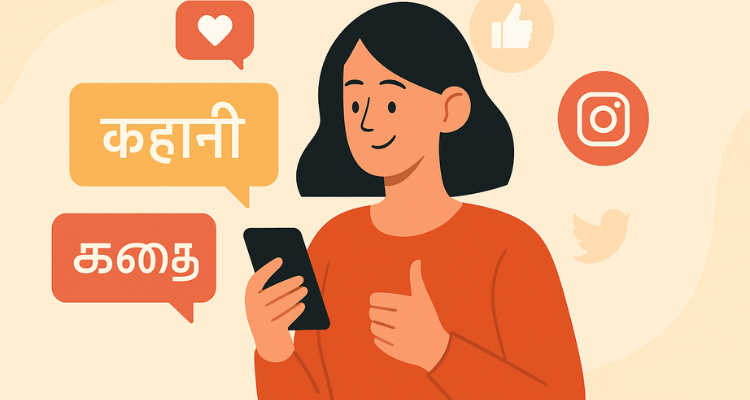
Some retellings are not just books but graphic novels, web series, social media threads, and reels. The packaging is oriented toward virality: quick hooks, visuals, shareable moments (“What if Karna’s year of exile was a Netflix mini-series?”). Also, cultural creators remix mythic visuals for Instagram/TikTok (though not always formally studied yet), the point: algorithmic forms change how the epic is consumed and retold.
Is there a sense of god-fear in the play?
By this I mean: are these retellings reverent, designed to reaffirm faith and awe, or are they playing with divine figures as pop-culture icons?
Some works remain devotional: retellings that emphasise the divine/higher moral order.
Others relocate gods to mythos: characters with agency, flaws, contexts. For example, the Malayalam novel R andamoozham recounts the Mahābhārata through Bhīma’s eyes, “avoids the divine elements and represents realistically.”
Thus, while some writing retains “god-fear” (i.e., reverence for the divine epic), others strip it away in favour of human drama. For the digital generation, perhaps the latter is more exciting; they engage with myth as a story rather than scripture.
Is there an attempt to paint a “negative” picture around myth-characters to “destroy faith”?
This is a charged question, but worth exploring. Retellings inevitably raise questions like: Are we undermining faith by depicting Yudhiṣṭhira’s moral ambiguity? Or Karṇa’s injustice? By showing gods/geniuses with flaws?
Many critics worry that retelling epics in “critical” mode may undermine traditional religious reverence.
On the other hand, many authors argue they’re expanding faith: by humanising gods/heroes rather than diminishing them.
In short, while some retellings might feel aggressively revisionist (which some readers interpret as “negative”), many are simply reframing, offering nuance rather than destruction.
So what is happening culturally?
- We’re seeing a democratisation of epics. The right to reinterpret, remix, and retell is broader.
- We’re also seeing fear-and-faith co-existing: the epic continues to be sacred, but also subject to critique, play, and pop remix.
- The algorithmic era amplifies this: retellings that provoke, surprise, and invert are more likely to go viral. That means there’s both commercial incentive and a cultural shift.
Why are these retellings going viral or becoming popular?
Let’s zoom into the “viral mechanics”.
- Familiar brand + fresh angle: Readers already know “Mahābhārata war, Pandavas vs Kauravas”. But a twist (“What if Karna narrates?”) gives novelty. That combination is algorithmically potent.
- Short-form shareable moments: A retelling might produce quotes/snippets: “Karna’s loyalty cost him more than his caste.” These become tweetable, Instagrammable.
- Visual and multimedia potential: Mythic imagery is dramatic; social media loves dramatic visuals. Retellings provide new visuals (dark Kor battles, female POVs, comic-style art).
- Relatable themes for digital natives: Identity crises, rejection, outsider voices (Karna, Shakuni), trauma of legacy wars — these resonate with younger readers who feel themselves in transitional, uncertain lives.
- Cross-media promotion: Many retellings tie into series, podcasts, influencer book talks, and author Q&As. Algorithmic visibility rises.
- Controversy = traction: A retelling that appears to “reinterpret sacred text” may stir debate (social media loves debate). That drives more eyes.
Risks and reflective notes
- Over-commercialisation: Myth becomes merely a “brand” for clicks. When retellings prioritise shock or sensationalism, the epic's depth may get lost.
- Cultural backlash: Some audiences may see certain retellings as disrespectful to faith traditions. That can provoke social-media storms.
- Loss of complexity: The epic’s nuance may be flattened into bite-sized tropes (Pandava good / Kaurava evil) in the name of virality. Ironically, this undercuts what made the epic enduring.
- Algorithmic homogenisation: If authors chase “what clicks” (villain POV, female hero), we may see formulaic patterns rather than truly original takes.
Then why keep retelling? The optimism
Despite risks, I remain optimistic about the trend, and here’s why:
- Retellings keep myth alive. Without reinterpretation, epics risk being museum pieces. Fresh voices help them live in new contexts.
- They invite questions, not just answers. When an author asks, “What if Karna had another choice?” we invite the reader into the epic rather than simply consuming it.
- They build bridges: between past and present, between reading and scrolling, between India and the global diaspora.
- Finally, they reflect the algorithm era’s demand for story, identity and meaning. When everything fragments online, myth offers something structural, expansive, communal.
Indian writers and creators are remixing epics not to erase tradition, but to re-engage it, with drums of war, voices of the marginal, glances of the gods, in formats that speak to TikTok seconds but also to timeless human anxieties. Whether you are a reader who flips quickly or a scroll-stopper who lingers, these retellings offer both familiarity and discovery. And in an age of algorithms that reward novelty and resonance, perhaps the very digital medium is what the epic always implicitly asked of us: attention, reflection, and a sense of our place in the bigger story.










Add a comment
Add a comment