
Why Microfiction Is the New Bestseller
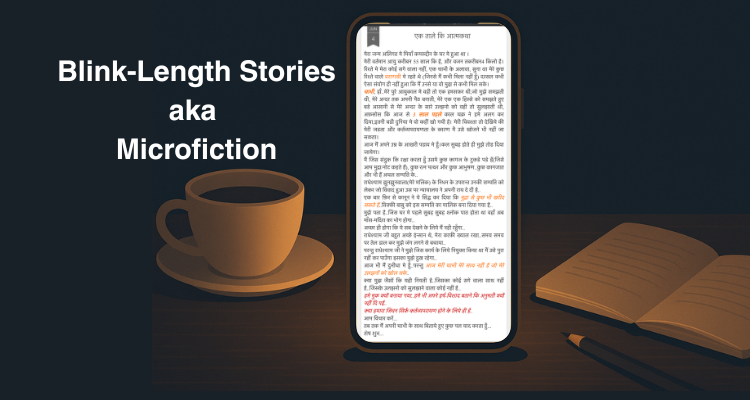
And the story’s over. But... you’re still thinking about it.
Once upon a time, stories were told in chapters to build. Now they unfold between two swipes.
And yet, when done right... a 100-word story can still hit harder than a 400-page novel.
You’ve seen them, Tiny stories on Instagram, Threads, Facebook, Rachnaye, or those neatly packaged Terribly Tiny Tales that make you stop scrolling, exhale, and whisper, “Oof, that hit hard.”
This is the golden age of Microfiction, the art of saying everything and nothing in the space of a sigh.
What Exactly Is Microfiction?
Microfiction is the minimalist cousin of the short story. Usually between 50–150 words, it’s compact, deliberate, and deceptively simple.
Every sentence works like a heartbeat, quick, necessary, precise.
A good piece of microfiction doesn’t just end; it lingers. It leaves that invisible aftertaste, something between ache and awe.
Writers often joke: “Writing short is the longest thing you’ll ever do.”
Why Readers Can’t Get Enough
Because attention is the new currency
Let’s be honest...nobody has time. Between Instagram reels, WhatsApp forwards, and AI summaries, the human attention span has gone from goldfish to glitch. Microfiction fits perfectly into that gap; it’s emotional fast food with gourmet flavour.
Because it gives instant payoff
There’s a satisfaction in reading a complete story in less than a minute. It feels like a sense of closure in a chaotic world. You start, feel, and finish something before your coffee goes cold.
Because emotion travels faster in miniature
A single line like —
“She saved his number, but never his name.” can punch harder than an entire breakup chapter.
Brevity, when mastered, becomes brutality.
How India Fell in Love With the 100-Word Story
Microfiction’s boom in India didn’t come from literature festivals... it came from phones.
Platforms like Terribly Tiny Tales, Rachnaye, YourQuote, and Medium democratized storytelling. Suddenly, you didn’t need a publisher, just a feeling, 100 words, and Wi-Fi.
And because India thrives on emotion... heartbreak, nostalgia, moral lessons, humour, microfiction became the perfect format for cultural storytelling.
Examples that hit home:
- Love stories told through missed calls.
- Friendship stories ending with “last seen yesterday.”
- Political satire disguised as everyday banter.
Short didn’t mean shallow; it meant sharper.
The Art (and Science) of Writing Short
Writing microfiction is like tightrope walking blindfolded.
One word too many, and you fall into clutter.
One word too few, and the meaning disappears.
Here’s how the best 100-word writers do it:
- Compression, not omission. They cut fat, not feeling.
- One emotion per story. There’s no room for subplots...only impact.
- The twist lives in the last breath. Every great micro-tale ends with an echo.
In essence, microfiction turns writing into sculpture; you carve till only truth remains.
The Indian Flavour of Microfiction
India’s microfiction is special because it carries vernacular rhythm and local heart.
Writers blend English with phrases from Hindi, Tamil, Marathi, or Bengali... making it raw, musical, and instantly relatable.
“Amma still waits with two cups of tea.
One for her, one for the son who promised to come.”
That’s not just a line, it’s a story, a lifetime, a mirror.
Rachnaye, in particular, has seen a surge in bilingual short-form writing, where emotions, rather than grammar, take the lead.
Enter the AI Ghost Co-Author
Let’s be honest, machines partly write some microfiction you scroll past today.
AI tools can mimic tone, emotion, and brevity, frighteningly, but what they can’t replicate (yet) is human silence, that unspoken tension between words that makes microfiction unforgettable.
In other words, AI can write a short story. But it can’t write your heartbreak, not yet.
Why Writers Love It
Microfiction gives writers what traditional publishing rarely does: immediacy. You write. You post. You watch reactions in real time.
You build a following, one line at a time.
And when readers start DM-ing “You wrote my life in 4 sentences,” and you realise, literature didn’t die on the internet. It just shrunk to fit your screen.
Deep Down, It’s About Memory
Microfiction works because it mimics how we think.
We don’t remember full stories; we remember moments.
Microfiction is literature reduced to its most concise form.
It’s the pause before a confession, the space between two texts, the sigh that ends a love story.
It’s human experience distilled into haiku-length honesty.
The Future Belongs to the Brief
In the attention economy, short is not a compromise; it’s an art form.
As storytelling evolves, 100 words might become the new bestseller format, not because readers are lazy, but because emotion no longer needs paragraphs to be profound.
A century ago, writers wrote chapters to say “I love you.”
Now we say —
“You left your book here. I read it anyway.”
And somehow, it’s enough... Alva?






Add a comment
Add a comment