
Imprints of Time
₹
540
₹ 448.2 (17% off)
Available
Imprints of Time (Kaalarekhalu) depicts a pivotal period in Telangana history through a compelling fictional narrative. It portrays the region under the oppressive Nizam, ruthless Zamindars, and the violence-causing “Rajakars.” The story emphasises the rise of “Andhramahasabha,” the emergence of communism, and Hyderabad’s integration into India, drawing from memoirs and eyewitness accounts. The narrative traces the lives and struggles of people during the decades following Andhra Pradesh’s formation, highlighting Telangana’s hopes, frustrations, and political awakening. Key Themes - Social-Political Struggle: The novel showcases Telangana’s fight against oppression. - Cultural History: It details Telangana’s socio-cultural development. - Individual vs. Society: Like Naveen’s other works, it examines characters’ psychology amid social transformation. Strengths - Authenticity: As an autobiographical novel, it provides a raw perspective on the struggles of the oppressed. - Unique Style: Naveen’s distinctive, experimental storytelling immerses readers in the era. - Historical Significance: It is an important addition to modern Telugu literature, recording a crucial historical period.
Read moreAbout the Book
Imprints of Time (Kaalarekhalu) depicts a pivotal period in Telangana history through a compelling fictional narrative. It portrays the region under the oppressive Nizam, ruthless Zamindars, and the violence-causing “Rajakars.” The story emphasises the rise of “Andhramahasabha,” the emergence of communism, and Hyderabad’s integration into India, drawing from memoirs and eyewitness accounts.
The narrative traces the lives and struggles of people during the decades following Andhra Pradesh’s formation, highlighting Telangana’s hopes, frustrations, and political awakening.
Key Themes
- Social-Political Struggle: The novel showcases Telangana’s fight against oppression.
- Cultural History: It details Telangana’s socio-cultural development.
- Individual vs. Society: Like Naveen’s other works, it examines characters’ psychology amid social transformation.
Strengths
- Authenticity: As an autobiographical novel, it provides a raw perspective on the struggles of the oppressed.
- Unique Style: Naveen’s distinctive, experimental storytelling immerses readers in the era.
- Historical Significance: It is an important addition to modern Telugu literature, recording a crucial historical period.
Book Details
THE CHARIOT
- Author Name:
Raghavendra Patil +1
- Book Type:

- Description:
Raghavendra Patil (b.1951) belongs to the postmodernist group of writers in Kannada. Like his predecessors, U.R. Anantamurthy, Yahvant Chittal, Tejasvi and Shantinath Desai, he arrived at the novel through the short story. The Chariot (Teru), which won him the Sahitya Akademi Award, is his second novel. Though Patil belongs to the postmodern era, he does not share the thematic concerns or techniques of Western postmodernism. He is closer to the nativistic movement, which has already produced major writers like Chandrasekhar Kambar and Kum. Veerabhadrappa. He has also inherited some of the qualities of his famous uncle Anandakanda, such as an interest in local history and closeness to rural life. The story that Patil tells in The Chariot spans more than a hundred and fifty years, beginning with the years when the Peshva extended his rule to North Karnataka and ending with the years after the Emergency, and it relates to the Belagavi region, with its epicentre in an imagined but fully realised village named Dharamanatti. The novel offers two images of Teru, which in Kannada means both the chariot and the festival associated with it. The first is centred on an atrocious human sacrifice made in the name of religion by an autocratic ruler, and the second, distanced in time by a century and a half, mirrors the change from the feudal order to a democratic one, where religious superstition and feudal practices have been replaced by scepticism and the politics of power. The novel is remarkable for its innovative technique, which handles myth and reality with equal success.

Anna
- Author Name:
C. N. Annadurai
- Book Type:
- Description:
Everyone regarded Anna as one of the most remarkable figures produced by Tamil Nadu. His greatness stems from the widespread acclaim he received from prominent leaders of his era. His various talents demonstrate his capabilities as an effective administrator, deep thinker, prolific writer, insightful journalist, and above all, a humanitarian that leaves us in awe of his literary contributions. He observed the living conditions of Tamils during his time and aimed to instigate change through his writing and speeches. Inspired by Periyar's thoughts and pride in Tamil heritage, he emerged as a towering advocate for humanism, dedicated to protecting the Tamil community and working toward their advancement. Anna once referenced influential figures like Shelley, Byron, Keats, Coleridge, Emerson, and Bacon, remarking that they are not foreigners in the truest sense. Is Tiruvalluvar simply a Tamil? They are all global citizens and educators, and Anna holds a similar esteemed position as a worldwide citizen. Anna is recognised as a pioneer in short stories that explore the tension between tradition and modernity. He is a relentless journalist and a guiding light as a dramatist. In addition to being a remarkable orator, his political acumen further defines him as the genius of his century. In summary, Anna is a true phenomenon.

Those Unsaid Words
- Author Name:
Anshuman Agrahri
- Book Type:

- Description:
Tanvi realises how the definition of love keeps changing and emotions were the last parameters she considered while deciding her life. As the destiny could play, her best friend dies on the very day of her marriage, and she starts inculpating herself for the misfortune, which leads to a fractured married life. She defies everyone and goes on a road trip to Leh. In the land of lamas she tries to understand life from the lens of spirituality and starts discerning threads of coincidences. The journey helps her to understand ‘Those Unsaid Words’ which cannot be said, cannot be written, cannot be gesticulated; can only be felt.

Baduku
- Author Name:
Geeta Nagbhushan +1
- Book Type:
- Description:
Dr. Geetha Nagabhushana's work primarily focuses on the struggles of the distressed, exploited, and naïve individuals from slums or the lowest strata of the Hindu caste system. Her unique storytelling provides a glimpse into real-life experiences that resonate deeply with us, rather than simply presenting fictional characters. The Kannada dialect used in "Baduku" deserves special recognition for its authenticity and cultural richness. Throughout the novel, the hardships faced by those in the lowest tiers of the Varna system are depicted without any apologies. The portrayal of women's struggles in "Baduku" serves as a critique of patriarchal society. The novel offers a comprehensive view of society, addressing various forms of atrocity and oppression, including issues related to class, caste, and gender, as well as the challenges faced by both urban and rural downtrodden communities. There is no fair treatment found in any of these intersections.

The Tale of a Place
- Author Name:
S.K. Pottekkat +1
- Book Type:
- Description:
Prema Jayakumar provides the English translation of S.K. Pottekkar's acclaimed Malayalam novel, ' Oru Deshanthinte Katha, ' published by Sahitya Akademi in 2015. The narrative centres on Sreedharan, a boy from Athiranippadam, portraying villagers' lives through the perspectives of the narrator and other characters. Set during British India, the story begins with Sreedharan's return to his hometown after more than 40 years. He is dropped near a petrol overhead tank on the site of his teenage love's house. He recounts the lives of the residents of Athiranippadam. The novel is segmented into five parts: childhood, early youth, teenage years, and a final section called "marmarangal." It features a story told by Velu Mooper, who witnesses events after Sreedharan's father's death, following his extensive travels to North India, Africa, and Europe. Throughout the story, he encounters individuals who leave lasting impressions from different stages of life, including Emma from Switzerland, a Bengali Babu, his half-brothers Kunhappu and Gopalettan (who caused him suffering by contracting syphilis), the mother goddess psyche of a Tamil Brahmin woman, with whom he longs, a girl who loved him unrequitedly before dying of tuberculosis, pranks with the " Supper Circuit Set, " lost loves, profound loneliness, his father's legendary life, and his journeys across continents. He started by dropping off his widowed mother at her family's home, initially at Elanhippoyil, then heading to Bombay- a solitary voyage into the vast, bewildering world, as SKP describes. This haunting autobiographical novel spans about 60 years of history, reflecting on themes of memory, nostalgia, hardship, dreams, and numbness. It concludes with a monologue: "Forgive me, the representative of the new generation of Athiranippadam, forgive me for trespassing into your land, and consider me merely an antique collector, a non-native!"

Daatu
- Author Name:
S.L. Bhyrappa +2
- Book Type:
- Description:
Daatu is a powerful novel that explores the rigid boundaries of caste and community in rural India, and what it takes to cross them. Set in Karnataka, the story unfolds around deeply entrenched social structures where identity is dictated by birth, and every step outside those boundaries comes at a cost. At its core, Daatu is about transgression — the act of “crossing over.” Whether it is caste, relationships, or social norms, the novel examines what happens when individuals challenge the invisible lines that define their lives. The narrative is layered with realism, capturing village life with honesty and nuance. It reflects how traditions, power, and fear shape human behaviour, while also revealing moments of resistance, dignity, and change. Recognised as a significant work in Indian literature, Daatu offers readers not just a story, but a lens into the complexities of caste, morality, and social transformation.

Jatara
- Author Name:
Boya Jangaiah +1
- Book Type:
- Description:
Jatara is a novella (1988) that deals with the predicament of women in the countryside. It graphically captures the realities of the village society in Telangana as major and minor characters come alive. The writer presents the theme of corruption in all its stark dimensions-physical and moral degradation, psychological and emotional blackmail, and surrender to superstitions and deceit from the point of view of the protagonist. The author remains objective, a bystander, in focusing on the bright and dark sides of the rural society, on interpersonal relations, and their belief systems, while subtly suggesting what was needed. For its humanist vision and gripping narrative, the novella remains a classic in Telugu fiction.

Joys and Woes are Woven Fine
- Author Name:
Arkaprava De
- Book Type:
- Description:
She was born in Kolkata. She was an unwelcomed guest, a product of lust. She had to pay the price. She was abducted and trafficked to Hyderabad. She spent nine years begging on the roadside. Destiny brought her back to Kolkata, where she was sold off to a procuress in Sonargachi. She married Raghu and started leading a healthy life. However, she attempted suicide. She was Ketaki. Why was Ketaki abducted and trafficked? Where were her father and mother? Was Ketaki ever able to meet her birth parents? Why did she attempt suicide? Was it all destiny that brought her back to Kolkata, or did The Almighty have something else in His holy mind? After all, Joys and Woes are always woven fine!!

Carvalho
- Author Name:
K.P. Purnachandra Tejaswi +1
- Book Type:
- Description:
Carvalho is one of the most widely read and admired novels of Tejaswi. It is a novek which can be read at varioud levels as it presents many worlds. The dream if science and mystery and the everyday world of ordinary but amazing men and women. The novel explored the various facets of our complex civilisation like agriculture law and politics. It is a novel which will apppeal to readers of all ages. To Children it will appeal as a story of adventure, mystery and thrill; grown-ups can enjoy it as a work which offers stimulating insights into the world of men and women and Nature, and connoisseurs of art can see in it a baffling and inviting vision of art and metaphysics and wisdom.

ONCE UPON A TIME
- Author Name:
A Sethumadhavan +1
- Book Type:
- Description:
Once Upon a time by A. Sethumadhavan, is a novel which surrounds priyamvada, who is an HR professional, and a single parent at the centre of its narrative. The strong undercurrent of this award-winning title is the way woman asserts her independence and deft strokes in the book suggest how a professional woman scores. The novel very beautifully depicts the personal journey of a single parent, where are dilemmas which priyamvada faces, doing a tightrope walk between the labor force and the managements, trying to fill the vacuum in her daughter’s life and consciously attempting to steady her own emotional moorings.

Two Letters
- Author Name:
Upendra Nath Jha 'Vyas'
- Book Type:
- Description:
Two Letters is the English translation of the Sahitya Akademi Award-winning Maithili novel, Du Patra. The novel is structured as two letters, written by two women to two men, not to one another. The narrative centres on four characters, with the two men being the recipients of the letters. The two women, placed at opposite ends of the cultural spectrum and value systems, grapple with the fundamentals of the cultural dichotomy between the West and India, under the shadow of their personal tragedies. The novel delves deeply into the women's inner selves and psyches. The first letter is written by Indu to her husband, Surendra, who has been in the USA for about a decade. When Ramesh, a cousin of Indu, goes to the USA for about a year and meets Surendra, he is introduced to a young American woman, Jessica, with whom he develops a friendship. On coming back home, Ramesh sends a copy of Indu's letter (written to her husband) to Jessica. The second letter is written by Jessica to Ramesh. Experimental in form, the novel is pacy in prose and intense in narrative.

Parva
- Author Name:
S.L. Bhyrappa
- Book Type:
- Description:
The novel narrates the story of the Hindu epic Mahabharata, primarily using monologue as a literary technique. Several principal characters from the original Mahabharata reminisce about their entire lives. Both the setting and the context for the reminiscence are the onset of the Kurukshetra War. Parva is acknowledged as S.L. Bhyrappa's greatest work. Non-Kannadigas who have read it in its Hindi and Marathi translations consider it one of the masterpieces of modern Indian literature. It transforms an ancient legend into a modern novel. In this process, it has gained rational credibility and a human perspective. The main incident, the Bharata war, symbolic of the birth pangs of a new world order, depicts a heroic but vain effort to arrest the disintegration and continue the prevailing order. It is viewed from the standpoints of the partisan participants and judged with reference to the objective understanding of Krishna. Narration, dialogue, monologue, and commentary are all employed for its presentation. Shot through with irony, pity, and objective understanding, the novel ends with the true tragic vision of faith in life and hope for mankind. Parva has been translated into several major Indian languages: Bengali, Hindi, Marathi, Tamil, and Telugu, apart from English. The novel narrates the story of the Hindu epic Mahabharata, primarily using monologue as a literary technique. Several principal characters from the original Mahabharata reminisce about their entire lives. Both the setting and the context for the reminiscence are the onset of the Kurukshetra War.

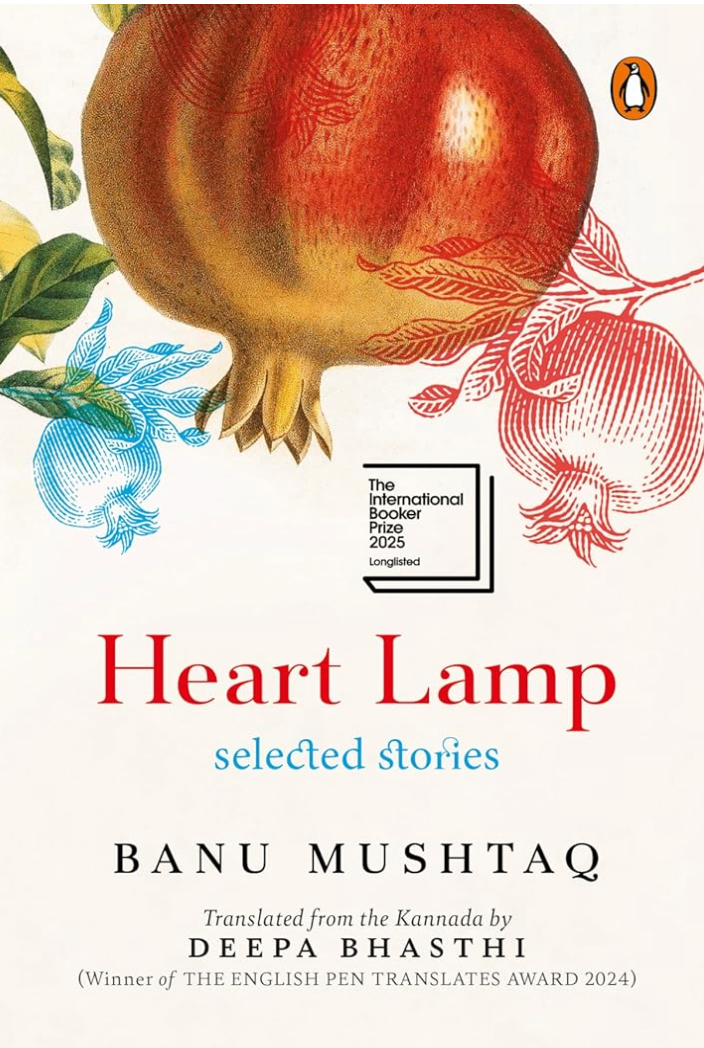
Heart Lamp
- Author Name:
Banu Mushtaq
- Book Type:
- Description:
In Heart Lamp, Banu Mushtaq exquisitely captures the everyday lives of women and girls in Muslim communities in southern India. Published originally in the Kannada, these portraits of family and community tensions testify to Mushtaq’s years as a journalist and lawyer, in which she tirelessly championed women’s rights and protested all forms of caste and religious oppression. Written in a style at once witty, vivid, colloquial, moving and excoriating, it’s in her characters – the sparky children, the audacious grandmothers, the buffoonish maulvis and thug brothers, the oft-hapless husbands, and the mothers above all, surviving their feelings at great cost – that Mushtaq emerges as an astonishing writer and observer of human nature, building disconcerting emotional heights out of a rich spoken style. Her opus has garnered both censure from conservative quarters as well India’s most prestigious literary awards; this is a collection sure to be read for years to come.
Saga of a Nerdy Girl (Illustrated)
- Author Name:
Anushree Pandey
- Book Type:
- Description:
Saga of a Nerdy Girl has been written by the geeky 11-year-old Anushree Pandey. This compilation of funny ways through which she faces obstacles life throws at her is bound to get the giggles out of all ages. She has indeed taken “when life gives you lemons make lemonade” to another level. This book is all about how her perspective to view the world. So, be prepared for the rollercoaster of emotions, fun and laughter.

Bunches
- Author Name:
Suvigya Sahu
- Book Type:
- Description:
Childhood is simple but teenagerhood is difficult not for the children only but for their parents too. This isthe story about a sincere girl Surveen. Surveen always believed in their parent's points of view in her life. When she entered the teenage phase of her life she started thinking about their point of view towards things. Surveen's parents and Surveen's point of view didn't match all the time. Parents need to understand the teenagers. In the teenage phase, Not only body organ development happening there is mental development too. Different hormones rush into the body of teenagers. But what happens when the simple sincere Surveen turn into a fun-loving girl and started hiding things from parents. roaming with sly friends and started bunking the class. She started feeling the love emotion toward someone. What will happen in Surveen's life next? Does she spoil her school life? Or does Surveen made mistakes in peer influence? or Can Surveen able to find her way of life?

Into the Oblivion
- Author Name:
Vineeta Chandak +1
- Book Type:
- Description:
This is not merely a tale. Reflecting upon the harsh realities of life, this book on one hand throws useful light on the various intricacies related to the treatment of Cancer, and on the other, penetrates deep into the spiritual world, and poignantly exposes the nuances of the difficulties of human life. Ultimately, it carries its protagonist far beyond the worldly bondages into the horizon of freedom, there, where everything remains forever ‘unsaid’.

The Ungrateful
- Author Name:
Ramesh Pokhriyal 'Nishank'
- Book Type:
- Description:
The person achieves his objective without fretting about anyone if he possesses the yearning and resolves to accomplish something for the society, but then there is that segment in our society that always maintains a negative approach towards everything. They especially strive to distract those who strive for society's betterment and create multiple obstacles in their path. A similar incident transpired with Ambuj to deviate him from his goal. At the same time, vicious circles were structured by the adversaries and by the personnel associated with his organisation. While moving through the path of truthfulness and noble feats, a person often passes through the long haul of sinister, shadowy conduits, where he might ramble in the confusion of his choice. Still, when he approaches the end of the dark tunnel, he encounters the golden rays of pleasant morning rays spreading its light. The novel The Ungrateful is another milestone in the powerful writing of famous litterateur Shri Ramesh Pokhriyal 'Nishank', which exposes both the morally upright, virtuous and ruthless and unscrupulous facets of society. It furnishes the hallmark of bonded, shattered, and reconnected associations.

Insanity Is The Gift
- Author Name:
Apoorva
- Book Type:
- Description:
Insanity is the Gift? The dreams we dream are often not our own but an accumulation of the surrounding we thrive. Our thoughts and opinions are slave to the experiences we have and the people we meet. But what happens when you finally break through the shell and try to chase a dream that is almost impossible. Insanity is the gift is a coming of age Novel that takes you on a journey through the lens of a bunch of childhood friends who are ambitious, dreamy, confused, authentic and most importantly - insane in their own way. As they go through college and discover themselves through music, love and friendships- not all things go according to plan. It is an story of finding true meaning of the meaninglessness of life. It tries to navigate and drift across contrasting characters to portray the different shades of love, fear, agony, dreams and human connections.

King Solomon Mines
- Author Name:
H. Rider Haggard
- Book Type:
- Description:
तीन अनजान पुरुष, एक धनी और पराक्रमी योद्धा, दूसरा एक जहाज़ी कप्तान और तीसरा जो मामूली लेकिन बड़ा ही अनुभवी शिकारी था। जब ये तीनों एक भटके हुए साथी की खोज में उस सफ़र पर निकल पड़ते हैं जिसके रास्ते अनोखे, अद्भुत, चमत्कारी और भयावह अनुभवों से भरपूर थे, जो की उन्हें बड़ी कठिनाइयों और एक महायुद्ध के बाद सुलेमान के ख़ज़ाने तक ले जाती हैं। वह सुलेमान का खज़ाना जिसके कीमती रत्नों के भण्डार तक पहुंचने वाला, सदियों पुराने शाप से शापित हो जाता। तो क्या इतनी कठिनाइयों के बाद उन्हें उनका खोया हुआ साथी मिल पाता है? क्या वह उस खजाने तक पहुंच पाते हैं? क्या वह उस सदियों पुराने शाप से बच पाते हैं? या फिर उन्हें खाली हाथ ही लौटना पड़ता है? यह अद्भुत कहानी उनके उस सफर की है जिसे कभी कोई पूरा नहीं कर पाया था। क्या उनका अनुभव, साहस, समझदारी, संयम और सूझबूझ, उन्हें उनके मंजिल तक पहुंचाने में सफल होता है?

Everything Will Be Alright
- Author Name:
Shubhanku Kochar
- Book Type:
- Description:
The novel is about two lovers cum friends, Nihal and Bhoomi, who leave their houses searching for fulfilment. They both have a dream. Nihal wants to win a gold medal in Mega events on an international platform, whereas Bhoomi intends to search for her biological parents as an adopted child. Both of them meet at a certain point and fall in love, and decide to get married even after the divine forces have declined their match. Along with this runs a parallel story of Antra and Apurva, who come from different backgrounds. They also fall in love with their terms for getting married. The story is full of magic realism where God and human beings, myth and reality, participate collectively in a specific direction. The attempt here is to experiment with the phrase: Everything will be alright. Humans tend to say to each other, "Don’t worry, Everything will be alright,” in our sheer exuberance, we keep challenging the unseen forces represented by God. The question that the novel poses before the reader is, “Can everything be alright?” Moreover, the intervention of God or Nature at various places is symbolic in asserting that human beings should not try to behave like the Lord of the Universe.

Customer Reviews
Be the first to write a review...
Imprints of Time reconstructs the violent closing chapter of feudal Telangana — the years when Razakars terrorised villages, Zamindars extracted tribute, and a popular movement forced Hyderabad's integration into independent India in 1948. Anchored in memoirs and eyewitness testimony, this fiction maps the emergence of the Andhramahasabha and the spread of communist ideology across a landscape still scarred by princely rule. It follows lives caught between loyalty to tradition and the pull of revolution, rendering a period often reduced to a historical footnote as lived, contested, and emotionally charged experience.
The narrative's power lies in its refusal to simplify. Characters navigate not just political violence but the slower cruelties of caste, gender, and economic dispossession. Published by Sahitya Akademi, the book situates personal memory within the turbulent formation of Andhra Pradesh, offering readers a regional history that reverberates in contemporary debates over statehood, identity, and the unfinished work of social justice in India.
What kind of reading experience does Imprints of Time offer?
This book delivers a sobering, layered experience — it moves at the pace of historical memory rather than thriller plot. Expect to encounter violence rendered without spectacle, political awakening shown through intimate choices, and characters whose moral clarity is hard-won. The narrative rewards readers who appreciate fiction as a form of historical witness, where emotional truth and documentary detail coexist. It leaves you with the weight of a period too often compressed into textbook sentences, now expanded into the texture of lived days.
Who should read Imprints of Time and what background does it assume?
This book is best suited for readers interested in regional Indian histories beyond the nationalist mainstream, particularly Telangana's distinct liberation struggle. It assumes curiosity rather than prior knowledge — the narrative contextualises the Nizam, Razakars, and Andhramahasabha as you encounter them. Readers drawn to post-colonial fiction, political movements, or communism's grassroots spread in India will find it compelling. It expects patience with a slower, reflective pace and a willingness to sit with moral complexity rather than heroic certainty.
Why does Telangana's struggle against the Nizam matter to Indian readers today?
Telangana's fight against feudal rule represents one of independent India's most violent integration episodes, yet it remains marginalised in national memory. The Razakar terror, peasant uprisings, and eventual police action of 1948 prefigure ongoing debates over regional autonomy, linguistic identity, and the legacy of princely states. For contemporary India — where Telangana achieved separate statehood only in 2014 — this history illuminates the long arc of struggles for self-determination, exposing how liberation narratives are unevenly remembered and whose voices get archived or erased.
What makes this book's portrayal of Telangana's liberation period distinctive?
Unlike purely documentary accounts, Imprints of Time grounds the political upheaval in the emotional and domestic lives of ordinary people — farmers, women, low-caste activists — rather than centring leaders or militias. Drawing from memoirs and oral testimony, it foregrounds subjective experience: fear, doubt, conversion to ideology, betrayal. The narrative refuses triumphalism, showing revolution as messy, incomplete, and morally ambiguous. This approach humanises a period often reduced to a historical milestone, restoring texture to what official timelines flatten into a single date: September 1948.
What does Imprints of Time leave readers with long after finishing it?
Readers carry away a sharpened sense of how violence imprints collective memory and shapes regional identity across generations. The book lingers as a reminder that political freedom is unevenly distributed — class, caste, and gender determine who benefits from liberation. Emotionally, it leaves a quiet anger at historical erasure and a renewed respect for the courage required to challenge entrenched power. Intellectually, it complicates the binary of oppressor and liberator, revealing how systems of exploitation outlive their formal dismantling, a truth still urgent in contemporary India.