
Gods, Giants And The Geography Of India
₹
399
₹ 327.18 (18% off)
Available
In the east, a pirate king finds his plans foiled by a formidable force of nature.In the north, a majestic mountain range emerges from a demon's tantrum. In the west, a sea keeps a city safely hidden in its deep waters. In the south, the avatar of a god gives a forest its name. Long ago, before science came up with explanations for the events that occurred in nature, people turned to stories to make sense of the wondrous workings of the natural world. And so, a life-giving stream became the gift of a goddess, a hot spring arose from the breath of a celestial snake and a heap of broken boulders served as a testament to a divine battle. Zigzagging through myths, folklore, local history and geological theories, this extraordinary book draws fascinating connections between ancient tales and the science behind the spectacular geography of India. Join Nalini Ramachandran on a most unusual, adventure-filled expedition up, down and across the country's varied terrain!
Read moreAbout the Book
In the east, a pirate king finds his plans foiled by a formidable force of nature.In the north, a majestic mountain range emerges from a demon's tantrum. In the west, a sea keeps a city safely hidden in its deep waters. In the south, the avatar of a god gives a forest its name. Long ago, before science came up with explanations for the events that occurred in nature, people turned to stories to make sense of the wondrous workings of the natural world. And so, a life-giving stream became the gift of a goddess, a hot spring arose from the breath of a celestial snake and a heap of broken boulders served as a testament to a divine battle. Zigzagging through myths, folklore, local history and geological theories, this extraordinary book draws fascinating connections between ancient tales and the science behind the spectacular geography of India. Join Nalini Ramachandran on a most unusual, adventure-filled expedition up, down and across the country's varied terrain!
Book Details
My Little Book Of Nava Durga
- Author Name:
Nalini Ramachandran
- Book Type:

- Description:
Let’s dive into the vast and wonderful world of Hindu mythology! This Navaratri, make way for the guardians divine, Goddess Durga and her avatars nine! With charming illustrations and simple language, this short tale about Nava Durga will entertain and delight. Collect all books in the series! WHY YOU SHOULD BUY THIS BOOK: AGE APPROPRIATE: Written in simple language to make reading easy for readers 3 and up STURDY AND DURABLE: Perfect for learning and playing for a long time SAFE FOR BABY: Handy format makes this safe for your baby PERFECTLY SIZED BOOKS: Easy and convenient for little readers to hold BRIGHT AND FUN PICTURES: To keep your little one interested and engaged A PERFECT GIFT: For every preschooler for a holistic learning experience

The Feminists
- Author Name:
JULIE GUIOL +1
- Book Type:
- Description:
We are all human. But for women, equality and the right to self-determination are far from being acquired! What are the conditions of women throughout the world? How have feminist movements been constructed over time? How can men be a part of feminism? The POCQQ collection deals with current topics with the perspective that allows everyone to form their own opinion.

A Do It-Yourself: Complete Guide SSB Interview Manual - Vol. 1
- Author Name:
Mohinder Pal Singh
- Book Type:
- Description:
The Services Selection Board (SSB) is a five-day personality assessment procedure conducted for officer-level selection for the Army, Navy, Air Force, and the Coast Guard. This book presents an in-depth and detailed analysis of the tests and suggests practical methods to prepare in a methodical way.

SSB DIY: Suggested Answers to FAQs Asked in SSB - Vol. 2
- Author Name:
Mohinder Pal Singh
- Book Type:
- Description:
Over 2,00,000 students appear in 5 days Services Selection Board interview process to become officers in Army, Navy, Airforce and Coast Guard every year. There are over 22 Selection Centres across the country which are involved in the conduct of SSB Interviews. This book is the compilation of questions contributed by students who attended the SSBs in the last two years. SSB interview procedure consists of a series of tests to gauge the leadership qualities (generally referred to as OLQs) of a candidate. These tests are conducted in three categories, Psychology Tests (TAT, WAT, SRT, SD), GTO tasks (GD, GPE, PGT, GOR, HGT, LECTURETTE, INDIVIDUAL OBSTACLES, CT, FGT) and Personal Interview. During the conduct of these tests candidates is put through many situations and asked various types of questions. SSB being a personality assessment there are no fixed solutions or responses to the questions/situations. The candidates remain in dilemma whether the answers they have given are right or wrong. Since last five years while I have been in AMAS lots of candidates have shared these questions and their predicaments over their answers. In this book I have tried to address these and give them guidelines as to how to attempt them in SSB. The answers may vary from person to person and each question can be answered in a number of ways. I have provided suggested responses which should act as guidelines to help the SSB aspirants frame their own answers.

A Do It-Yourself: Complete Guide SSB Interview Manual - Vol. 1
- Author Name:
Mohinder Pal Singh
- Book Type:
- Description:
The Services Selection Board (SSB) is a five-day personality assessment procedure conducted for officer-level selection for the Army, Navy, Air Force, and the Coast Guard. This book presents an in-depth and detailed analysis of the tests and suggests practical methods to prepare in a methodical way.

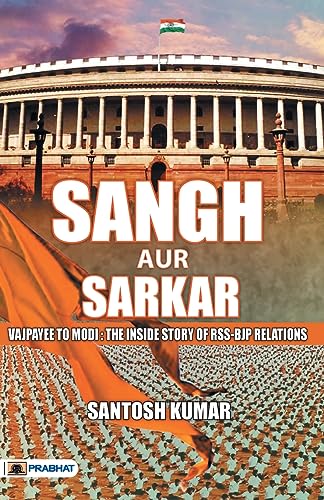
Sangh Aur Sarkar
- Author Name:
Santosh Kumar
- Book Type:
- Description:
This book lays out the nuances of all those stories of ‘Sangh and Sarkar’ layer by layer. Since the year 2014, there has been a wonderful example of coordination between the Sangh and BJP. Then there are many such examples like reservation, UP CM, BHU Vice Chancellor where there were possibilities of confrontation, but the matters were resolved in a few hours through dialogue. Social harmony for the penetration among Dalits, the campaign to create an intellectual movement after the JNU scandal, Pranab Mukherjee’s visit to the Sangh headquarters, the vision of ‘Future India’ from Vigyan Bhavan and finally, direct contact with three and a half lakh villages regarding the issues of the Modi government within the context of nationality not only increased the base of both the Sangh and the BJP, but the Vichar Pariwar also played an important role in preparing the ground for a bigger victory than in the year 2014. After the 2019 victory, ideological issues such as Article 370, Ram Mandir, etc. were swiftly dealt with so that commitment of those inclined towards the ideology of Sangh-BJP could be sealed. This book discusses how to take steps towards building new India by ending the gap of six decades in six years.
Visionary Dr. Hedgewar The Beacon of Vikasit Bharat
- Author Name:
N.H. Palkar
- Book Type:
- Description:
"Visionary Dr. Hedgewar: The Beacon of Viksit Bharat' is a rare and meticulously crafted biography that chronicles the extraordinary journey of Dr. Keshav Baliram Hedgewar, a visionary patriot, revolutionary organiser, and the founding Sarsanghchalak of the Rashtriya Swayamsevak Sangh. Drawn accounts, historical records, and decades of ideological immersion, this authoritative volume captures Doctorji's life with fidelity, grace, and reverence. from first-hand More than a mere biographical sketch, this work reveals the soul of a man who shaped one of India's most influential nationalist movements, rooted in discipline, selflessness, and cultural resurgence. From his early revolutionary years to the founding of the Sangh, Dr. Hedgewar's journey is presented not just as history, but as an enduring call to national reconstruction. This English translation of the original 'Hedgewar Charit' opens the doors of Doctorji's life to a wider audience. Scholars, swayamsevaks, and seekers of Bharat's civilisational truth. It stands as a timeless offering to those who believe that true leadership is born from unwavering conviction, spiritual clarity, and silent sacrifice."

31 GREEN HABITS TO SAVE OUR PLANET
- Author Name:
Shri Rohit Mehra (Irs)
- Book Type:
- Description:
Rohit Mehra is an IRS officer of 2004 batch. He is a man of versatile hobbies, passions and creativity. He is an author, blogger and motivational speaker. He is a passionate environmentalist and pioneer of vertical gardens in India. He is known as Greenman and has created more than 40 micro- jungles using the principles of Vruksayurveda and Miyawaki. He has planted nearly 7.50 lakhs plants in nearly 4 years and created more than 550 vertical gardens. He has spearheaded the movement of seed-balls in India and has got made and distributed close to 20 lakhs seed-balls in last 3 years which in itself is a record. He has created 2 mobile applications by the name ‘Sundari’ and ‘Election-Eye’. He has been the guiding force to create a mobile app ‘Tirth-yatra’. He is running a successful blog on personality development by the name ‘Design Your Destiny’. He has also written articles on various topics which have featured in national newspapers.

Swaraj Ka Shankhnaad
- Author Name:
Siddhartha Shankar Gautam
- Book Type:
- Description:
The real capital for the multidimensional progress of any nation is the common sense developed in its common citizens, resulting from their awareness of education. If we divide the population of India into two parts, one resides in those distant areas where there is no road, no government, no society, and they have clean water to drink. Those who are in close proximity to nature are richer in culture and values. Those who are away from nature, they are wrought with moral decline. What an irony is this? Where there is education and prosperity, there is no culture; and where there reside moral values, there is poverty and illiteracy. So, the solution lies in uniting both worlds through the bridge of intimacy. In this way, economic poverty will be ameliorated on one end, while cultural poverty will be ended on the other. The Ekal Abhiyan is dedicated to exactly this purpose. That is why it is also called ‘Gram Shiksha Mandir’. This book apprises you of the great mission known as Ekal Abhiyan, which is dedicated to education, culture, and self-rule.

Clymet Change
- Author Name:
Sharad Singh
- Book Type:
- Description:
This book has no description

Relevance of Savarkar Today
- Author Name:
Ashok Modak
- Book Type:
- Description:
Swatantryaveer Vinayak Damodar Savarkar (1883-1966) was a multidimensional personality - a freedom fighter, social reformer, writer, poet, historian, political leader and philosopher all combined into one. Savarkar's ideas of modernity, social and religious reforms, cultivation of scientific temper and embracing technological tools continue to be relevant in the 21st century. "Relevance of Savarkar Today", 25 pearls of visionary wisdom by Veer Sawarkar, is the product of deep study and research by Dr Ashok Modak. Savarkar's quotations, the author's expert comments and nearly 60 supportive comments by senior political leaders, social reformers, and intellectuals in 25 chapters illustrate the relevance of following the visionary messages of Savarkar for a new India of the 21st century. Bring out a solid, cohesive social fabric through unity Hindutva embraces the whole being of the Hindu race Brave foreign policies for the total defence of India Strong India for the real happiness of humanity.

Chandausi Junction
- Author Name:
Shankar Sahay
- Book Type:

- Description:
A collection of short-stories set in the 20th Century India for the 21st Century kids & a nostalgic walk, for their parents & grandparents. Although this book has been named after the city of Chandausi, it contains stories from various places like Rishikesh, Agra, Champaran, Tilhar, Sambhal, Kanpur, Banaras, Lucknow and many others. These are the short stories of a bygone era-a period when India had either not gained independence or had been independent for not more than 35 years. These are the tales of journeys-taken up from the early 20th century to the end of a millennium, from Shahjahanpur to Delhi, from Bijnor to Hyderabad, from Hathras to Sweden & Norway, from Lakshmi Talkies, Allahabad to Night Watchman, Bangalore, from Panki to USA, from Dehradun to Canada, from Chandausi to Australia and many others. We are sure in all these stories, you will be able to find at least one character, which reminds you of your own self-of what you are, were or always wanted to be. Let us know the character with whom you have been able to relate to the most. Happy reading. “Genius is one percent inspiration and 99 percent perspiration,”-Thomas A. Edison. -Here’s a collection of short stories to inspire the readers.

Unjudging Women
- Author Name:
Rachna Chaudhary
- Book Type:
- Description:
This book is based on a critical feminist reading of selected Delhi High Court judgements pronounced in the 1990s. It focuses on the phenomenon of female criminality and the pervasiveness of the disciplinary powers of law in our lives. Through an overview of existing studies on female crime in India and the interaction with the working) of the law and the legal system, This engagement pushes our understanding of law from an instrument of control and mode of social transformation to mere rhetoric. Not to argue for the futility of engaging with the law but emphasising the need to look at it closely and critically.

Child Health And Nutrition In India
- Author Name:
Sanjay Prasad +2
- Book Type:
- Description:
This book is an attempt to present, in a consolidated form of research articles that can provide a common platform for communication and discussion about healthcare and service providers, functionaries, scholars and social workers involved with child health and nutrition. The scope of this book is to present an overview of child health, maternal health and community issues in India and also attempt to highlight some of the important issues in this field.

Case Files of The Dead
- Author Name:
Various Authors
- Book Type:
- Description:
Welcome to a mysterious land where ghosts. Ghouls and spirits rule. Welcome to a place where haunted houses and evil souls will make a shiver run down your spine. A spooky tale in the scenic hills of Mussoorie awaits you while uncanny happenings in a literary competition are sure to intrigue you. The case of a mysterious white Maruti baffles everyone, even as the unsuspecting jogger experiences something he had never bargained for. A group of friends will encounter the worst terror of their lives while nightmares of his death rack the young man! Author's In and The Book Bakers present an eclectic mix of true stories, legends, and fables that have often been a part of India's folklore—armed with some of the best authors in India's paranormal literature history. CASE FILES OF THE DEAD; India's first pure horror public anthology will turn every host into (G)Host!!!

Mathematics Wizard Srinivasa Ramanujan
- Author Name:
Narendra Govil +1
- Book Type:
- Description:
Mathematics Wizard Srinivasa Ramanujan The book depicts the interesting story of a mysterious Indian mathematician, Srinivasa Ramanujan, with no college education, whose mathematics in a series of letters to a Cambridge Mathematician, G.H. Hardy, shook the entire mathematics community. It is an exciting journey of a poor, self-taught and god-gifted mathematician who by the age of 31 became the youngest Fellow of Royal Society of London. Even after almost 100 years of his death at the age of 32, his results mysteriously find applications in modern world such as in the study of black holes, quantum gravity, cryptography and many others. Ramanujan’s life story and work has inspired numerous people and generations of mathematicians around the globe and continue to excite even today. We hope that the book will reach the current generation and generate interest in mathematics.

Kailas: Shiva's Abode
- Author Name:
Hemant Sharma +2
- Book Type:
- Description:
Wanderlust and the desire to know the land and society more had been fueling my wish to visit Kailas. There were many curiosities. All our major rivers have their source in the region. The largest reservoir of fresh water on earth is situated there. The celestial swans are found there. I recall that how in my childhood, my Grandmother used to describe Kailas as being akin to a dreamland. According to her, Shri Krishna has said in the Gita – Meruru shikhirinamaham – ‘Among mountains I am Kailas!’ It was Sage Mandhata who first set foot on this sacred soil. Adi Shankaracharya shed his mortal body here. Guru Nanak meditated here and Swaminarayana, the founder of the sect that bears his name, saw the vision of god here. The Ramayana and the Mahabharata mention Kailas. This is where Ravana had worshipped Lord Shiva. He wanted to take Kailas with him. Shiva guilefully dissuaded him from doing so. Arjuna performed penance here and received the Pashupata Astra from Shiva. Yudhishthir proceeded heavenwards via this route. One by one, all the family members fell by the roadside; only the faithful dog kept company. Bhasmasur, the Rakshas, a devotee of Shiva was reduced to cinders here. Today the dark shadow of civilisation has begun to fall even on Mansarovar. This lake is shrinking. The sacred water body, that once stretched across 410 square kilometres, is now shrunk to only 10 square kilometres. Consider this the rage of Nature. Had Kalidasa been alive, he would have been deeply saddened to see his beloved Himalaya in this state. Is it the same Himalaya that is described in Raghuvamsham and Kumar Sambhavam? Civilisation has reached a point where the divine dimensions of Himalaya are disturbed.

An Alternative Perspective On Education
- Author Name:
Atul Kothari
- Book Type:
- Description:
Education is the foundation of the development of any country. But in our country, the First Education Policy was framed in 1968, 21 years after independence; the second policy was formulated in 1986; 34 years later, India got the National Educational Policy-2020 on 25th July, 2020. Besides these, certain commissions were also constituted for reforms in education, which made some good recommendations, but these could not be implemented for sheer want of political will. For an instance, the Kothari Commission in 1968, recommended 6 per cent of Gross Domestic Product (GDP) for expenditure on education, which was also adopted by the Education Policy-1986, but this is yet to be translated into practice. If we ignore pre-colonial period, the Bharat of post-independence has not yet been able to determine the aim of education. Character building and moulding a human i.e. holistic development of personality should be the aim of education. Essays on related subjects are included in this book. To identify the issues and problems that plague the education, and their solution, we carried out basic but innovative experiments in schools, colleges and universities. The original experiences of these exercises have been penned down as articles and research papers. This book is an anthology of the related writings.

The Power of Your Subconscious Mind
- Author Name:
Dr. Joseph Murphy
- Book Type:
- Description:
The Power of Your Subconscious Mind, one of the most popular bestselling inspirational guides of all time, shows how changing your thought patterns can produce dramatic improvements in your life. Using practical, easy-to-understand techniques and real-world case studies, Dr Joseph Murphy reveals the vast influences of the subconscious mind on all aspects of existence-money, relationships, jobs, and happiness and how you can apply and direct its power to achieve your goals and dreams. Through this book, DDrMurphy provides the readers with the tools that one would need to unlock the extraordinary powers of their subconscious mind. One can improve relationships, finances, and physical well-being by following it. Once a person has learned how to use this unbelievably powerful force, there is nothing they will not be able to accomplish.

The Road to Infinity
- Author Name:
Tanbir Dhingra
- Book Type:
- Description:
"A Self-Exploratory Odyssey to ‘Infinity’ and ‘Beyond’ with Infinite Thoughts encapsulating Infinite Emotions in Infinite Moments giving Infinite Chances to explore ‘Who You Are in the quest for ‘What Is life’. A magically crafted peregrination of quotations reveals a deep longing for a greater sense of meaning, happiness and contentment. It helps to create enchanting thoughts that incorporate the classic tools of transformation into a simple philosophy of living. This is not just another book that should find its way to the self-help shelf; rather it’s a coach to motivate you and a best friend to inspire you forever. The book teaches us wisdom to: Build a Life of Passion, Purpose and Peace Value Time as our most important commodity Stay Fit by creating healthy habits not restrictions Nourish our Relationships and value things we Love Cultivate innovation of Colors and creativity from Nature

Customer Reviews
Be the first to write a review...
Gods, Giants And The Geography Of India by Nalini Ramachandran bridges the gulf between ancient storytelling and modern geological understanding. Zigzagging through myths, folklore, local history, and geological theories, this extraordinary book draws fascinating connections between ancient tales and the science behind India's spectacular geography. The places and stories she chose include Mathura as a city under the ocean; rivers like the Narmada and the Karewa Lake; the Himalayan ranges; Rama Sethu and Dhanushkoti as a Bridge city; and Hampi as an architectural wonder. Before the language of plate tectonics and erosion existed, communities across India explained hot springs as the breath of celestial snakes and river origins as divine gifts—Ramachandran recovers those narratives and sets them alongside the terrain itself. Her treatment is neither dismissive of folklore nor uncritical of it; instead, it honors the explanatory impulse that drove pre-scientific wonder. Published by Hachette India, the book invites young readers on what one reviewer called "a most unusual, adventure-filled expedition up, down and across the country's varied terrain."
What kind of reading experience will Gods, Giants And The Geography Of India give me?
Gods, Giants And The Geography Of India offers an intellectually layered journey rather than a straightforward narrative. You move between creation myths, local beliefs, and geological explanations for the same landform—a hot spring, a mountain range, a sunken city—experiencing the friction and harmony between ancestral storytelling and empirical science. The tone is curious and exploratory, not didactic. Each chapter invites you to hold two explanations in your mind at once, honouring the imaginative logic of folklore while appreciating the precision of geology, leaving you with a richer sense of how humans have always sought to make sense of the land beneath their feet.
Who is Gods, Giants And The Geography Of India best suited for, and what does it expect of its reader?
Gods, Giants And The Geography Of India is best suited for young readers (ages 10 and up) with curiosity about Indian mythology, geography, or the history of ideas—and for adults who want to revisit familiar landscapes through a dual lens. It expects a reader willing to move between narrative modes: one moment you're inside a demon's tantrum, the next you're considering tectonic plate movement. No prior knowledge of geology or mythology is required, but an openness to seeing the same place described in radically different terms—mythic and scientific—will deepen the experience significantly.
What is the cultural significance of Gods, Giants, And The Geography of India for Indian readers today?
In an era when Indian students often learn Western mythologies more thoroughly than their own regional folklore, this book reclaims geomythology as a living archive of pre-scientific knowledge. It reminds contemporary readers that the stories their grandparents told about rivers and mountains were not mere superstition but imaginative frameworks for understanding natural phenomena. At a time when India's environmental crises—melting glaciers, polluted rivers—dominate headlines, reconnecting with the reverence and wonder encoded in these origin tales offers both cultural continuity and a lens for reimagining our relationship with the land.
What makes Nalini Ramachandran's treatment of this subject distinctive in Gods, Giants And The Geography Of India?
Ramachandran refuses to position myth and science as opposites. Instead of debunking folklore or romanticizing it, she places each story alongside the geological explanation for the same feature—a river's course, a mountain's formation—and lets both speak. This dual-track structure honors the explanatory ambition of pre-scientific communities while equipping young readers with contemporary geological vocabulary. Her selection of sites spans India's geographic and cultural diversity, from the Himalayas to Rama Sethu, ensuring that no single region or tradition dominates, and her accessible prose makes complex geological processes legible without condescension.
What does Gods, Giants And The Geography Of India leave the reader with—emotionally, intellectually, or culturally—long after they finish it?
You finish this book with a doubled vision: every mountain, river, or forest in India now carries both a mythic origin and a geological timeline. Emotionally, it instills respect for the storytelling ingenuity of ancestors who, lacking modern instruments, still grasped that the earth was dynamic rather than static. Intellectually, it models a way of thinking that doesn't discard old knowledge when new frameworks arrive but instead holds them in productive tension. Culturally, it deepens your sense of rootedness—each landscape becomes a palimpsest where divine battles, local legends, and tectonic shifts are inscribed together, waiting to be read.