
Hampi nunchi Harappa daka
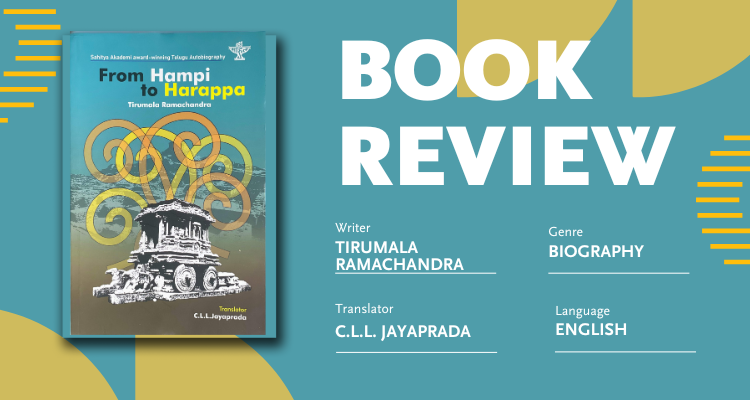
In the landscape of twentieth‐century Telugu literature, certain autobiographies stand out for their candour, cultural sweep and historical resonance.
“From Hampi to Harappa” is widely regarded as one of the top ten Telugu autobiographies of the twentieth century.
What makes this book remarkable?
The author Tirumala Ramachandra, born in a Sri Vaishnava family in 1913 in the border region of what is today the Karnataka–Andhra border, was steeped in Sanskrit, Telugu, Kannada and Prakrit scholarship. Yet his life was far from the comfortable path expected of a traditional scholar: he experienced hunger, travelled across India searching for employment, held a variety of jobs, and lived through the swirl of India’s pre- and post-Independence upheavals.
About the Author
Tirumala Ramachandra (1913-1998, approximately) was brought up in a Vaishnava Brahmin family deeply rooted in tradition, yet educated in multiple languages and literary traditions.
He had mastery over Sanskrit and multiple Indian languages. Still, his early adult life was marked by economic hardship and restless movement. The book recounts how he survived on little food, even drinking Ganga water while waiting in Kanpur, and held diverse jobs, including a manuscript library cataloguer, hotel worker, havaldar clerk in the military, and later in journalism.
What is compelling is his honest self‐reflection: the conflict between his orthodox Vaishnava upbringing and the modern, nationalist, even extremist ideas he flirted with during the freedom movement, and how he found his own path again through personal struggle.
Thus, the author is both scholar and wanderer, devotional and restless, rooted and uprooted, making his narrative rich for readers interested in Indian language literatures, regional cultural history, and life in India during the mid‐20th century.
Why This Book Belongs to the Top Ten?
- Depth of scholarship + breadth of life experience: Rarely, someone well‐versed in Sanskrit, Telugu, Kannada, Prakrit, and linguistic scholarship undergoes the kind of humble, itinerant life Ramachandra did. The juxtaposition of high erudition with everyday survival gives the narrative a unique texture.
- Cultural‐historical sweep: The title “From Hampi to Harappa” is itself symbolic, from the Vijayanagara heartland (Hampi) to the ancient Indus civilisation site (Harappa), signalling that the book is not just a personal memoir but a journey across Indian civilisations, languages, and geographies. The description notes how the author lived in places ranging from Tanjavur (South India) to Quetta (then in Balochistan) and situates his life within the larger sweep of India’s cultural and nationalist history.
- Honesty & self‐reflection: The book does not hide the author’s failures, his hunger, his ideological wanderings. This candidness creates authenticity. Already from the book description: “his honesty, self-reflection, and the conflict between his traditional Vaishnava beliefs and modern education” make this book remarkable.
- Literary quality: Reviews mention that the Telugu original “హంపీ నుంచి హరప్పా దాక” has sixty‐one chapters, each read like a story, and sustained with creative emotion and craft. This highlights the work’s literary merit, not just its historical significance.
- Historical relevance: The book offers firsthand glimpses of India during the freedom movement, regional literatures, manuscript libraries, and the intellectual milieu of mid-20th-century South and North India. For a reader interested in Indian language movements, the freedom period, or Indian intellectual history, this is a goldmine.
Hence, for Indian literatures (especially Telugu), cultural history, and autobiographical writing, this book holds a special place.
Who Should Read It?
- Readers of Telugu literature (and those comfortable reading it in English translation) who want to engage with one of the major autobiographies of the language.
- Scholars or students of Indian language literatures, especially those interested in the intersections of Sanskrit, regional languages, and manuscript culture.
- Readers interested in Indian cultural history: the freedom struggle, regional intelligentsia, migration for work, and everyday life in India across decades.
- Anyone who enjoys powerful life‐stories: someone who traversed social stations, struggled with hunger and survival, yet retained intellectual vigour and self-questioning.
- Writers and translators exploring the autobiographical genre in the Indian context: this book offers a template for blending selfhood with social history, language transitions, tradition, and modernity.
What Are the Strong Aspects of the Book?
- Vivid Episodic Narration: The life episodes are memorable: hunger when his mentor suffered, and surviving on Ganga water in Kanpur while waiting for a conman’s business promise. These give the book narrative punch. Already cited in the book description.
- Language and Scholarship: The author’s mastery over multiple languages allows him to reflect on the linguistic and cultural textures around him, for example, when living among Sanskrit scholars, Telugu newspaper environments, manuscripts, and so on.
- Cultural Cross-sections: The book offers glimpses of manuscript libraries, hotel work, military clerking, newspaper journalism, and nationalist activism, diverse worlds seldom captured so holistically.
- Inner Conflict & Transformation: The conflict between his orthodox Vaishnava roots and modern education, his involvement in extremist nationalist ideas, and his eventual self-path give the narrative moral and philosophical depth.
- Historical Value: In the Indian context of the 1930s–50s, the migration of intellectuals, economic hardship even among scholars, regional and linguistic ruptures, and the role of newspapers and manuscripts in cultural life all come alive.
What Are the Weak Elements?
Every work has limitations. Here are some possible caveats for a reader to keep in mind:
- Translation Quality: Some readers have reported that, although the book is excellent, the English translation occasionally falls short in comparison to the original.
- Narrative Focus & Rhythm: Because the book spans a long period of life, multiple geographies, jobs, languages, and transitions, the narrative sometimes feels episodic rather than tightly plotted. Some readers may prefer a smoother narrative arc.
- Context‐heavy: For readers unfamiliar with Indian regional history, South Indian Vaishnava culture, Indian manuscript libraries, or the turmoil of the freedom era in India, some chapters may require background knowledge to be fully understood.
- Selective Reflection: While the book is introspective, there may be sections where the author glosses over or skims specific episodes (for instance, ideological turns), leaving the reader wanting more internal reflection.
- Limited Modern Critical Apparatus: The book may not include extensive critical commentary, annotations for non-Telugu readers, maps, or contextualization of all the places mentioned (e.g., Hampi, Harappa, Quetta). For a contemporary reader seeking a comprehensive historical context, supplementary reading may be necessary.
My Personal Reflection
As someone invested in Indian languages and literatures, I found this book profoundly moving for the following reasons:
- It reminds us that scholarship and hardship often go hand in hand in India’s literary history; the clean image of the “academic scholar” is disrupted here by hunger, odd jobs, and the struggle for survival.
- It underscores the rich mosaic of Indian civilisation: from Hampi (the Vijayanagara Empire) to the Indus Civilisation region (Harappa) and across diverse geographies, languages, and lives. This aligns beautifully with your platform’s goal of bridging the gap between Indian languages and authors.
- For children and young readers of Indian language literatures, this could serve as an inspiration: that a Telugu author didn’t just stay in one place but travelled, struggled, persisted, and yet produced a work of lasting value.
At the same time, I wish the book had more extensive editorial apparatus (footnotes for the many places, times, and political references), especially for readers outside the Telugu milieu. Additionally, the English translation could be smoother. But these are minor relative to the richness of the content.
Add a comment
Add a comment