
Loved, But Legally Forgotten

A Write-up from a Legal Research Scholar Specialising in Intellectual Property & Indian Publishing. It's not just academic but personal; we attempt to offer a consultation, not in a courtroom, but in a conversation.
Scene: Delhi, 9:15 AM. A Writer Walks Into Court.
She clutches a file thick with manuscripts, contracts, and two cease-and-desist notices.
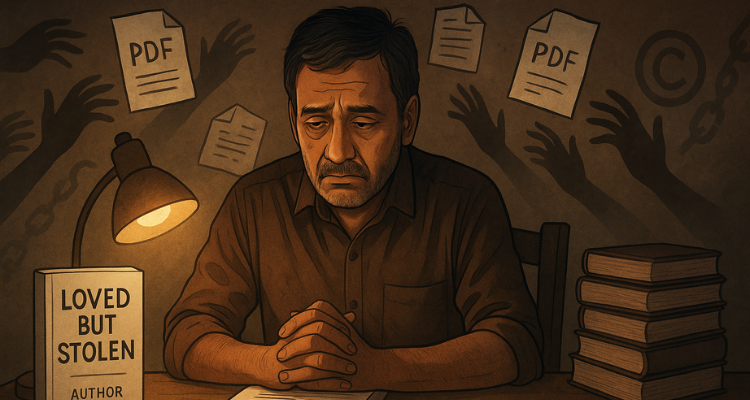
They were never meant to end up here—in a courtroom. But her debut book, after selling a few hundred copies legally, began appearing everywhere online: Telegram groups, Facebook pages, untraceable blog links. A pirated PDF of her life’s work had gone viral.
Her royalties? Gone. Her publisher’s support? Limited. Her legal protection? Questionable at best.
“I thought copyright was automatic” she says to the advocate, exhaustion in her voice.
“It is”, he replies, “But protection? That’s a whole different story.”
In India, this story isn’t fiction. It’s every writer’s reality.
You write. You publish. You share.
But what happens when your creation becomes a commodity—freely forwarded, illegally hosted, and spread across the digital world faster than the law can catch up?
Copyright in India: The Law on Paper
India’s primary IP legislation is the Copyright Act, 1957, last amended in 2012.
Section 14: The Meaning of Copyright
It grants authors exclusive rights to:
- Reproduce their work
- Publish or distribute it
- Translate or adapt it
- Communicate it to the public
These rights apply to literary, dramatic, musical, artistic, and digital works.
Section 17: The Author is the First Owner
Unless the work is created under employment or contract, the author is deemed the first owner of the copyright. In simple terms: You write it, you own it.
Sounds good? On paper, yes. In practice, not always.
Where the Law Fails Writers
1. Digital Piracy Prosecution is a Dead End
Despite Section 51 (defining infringement) and Section 63 (criminal liability), very few digital piracy cases are successfully prosecuted in India.
The Information Technology Act, 2000, meant to aid digital protection, lacks specifics on how creators can file complaints or have pirated PDFs removed from platforms.
There’s no DMCA-like takedown mechanism. No dedicated IP cell for publishing. No fast-track court for urgent infringement cases.
2. Platforms Are Shielded, Not Accountable
Section 79 of the IT Act gives “safe harbor” protection to intermediaries like Telegram or file-hosting services. This means even when they host pirated books, it’s nearly impossible to hold them liable unless the content is explicitly flagged and ignored.
But how many authors even know how to issue takedown notices? How many can afford a lawyer to help?
3. Unregulated Contracts = Long-Term Exploitation
Indian writers—especially in regional languages—often sign publishing contracts without legal review. These documents typically:
- Assign all rights (digital, translation, audio, film) permanently
- Offer flat advances without royalty audits.
- Omit reversion clauses for unsold rights
- Allow global exploitation without transparent reporting.
There’s no statutory mandate for publishers to disclose sales or royalty reports. It’s a black box.
Gaps the Law Doesn’t Even Touch
1. AI and Machine Learning Exploitation
AI models are trained on massive amounts of content—books, articles, poems. Globally, lawsuits have been filed (e.g., The New York Times vs. OpenAI), but India has no regulation on this yet.
Your book could be scraped and turned into AI-generated text—without attribution, compensation, or legal recourse.
2. Audiobook, Podcast & Voice Licensing Gaps
Audiobooks are treated as derivative works, yet there’s no clarity on:
- Royalty shares with narrators
- Ownership of audio IP
- Cross-platform licensing terms
Voice-over creators and writers alike are exposed, with no protective framework under current copyright law.
3. No Digital Enforcement or Writer Helpline
Unlike the film industry, publishing lacks:
- A piracy complaint cell
- A digital content registry
- A support portal for authors facing infringement
No institution helps a writer when their work is stolen—legally or digitally.
Legal Precedents Worth Knowing
R.G. Anand v. Delux Films (1978)
This case clarified that copyright protects expression, not ideas. Writers must prove substantial, literal copying—not just thematic similarity.
🔍 Takeaway: Protect your specific wording, structure, and unique storytelling—not just your plotline.
University of Oxford vs. Rameshwari Photocopy Service (2016)
The Delhi High Court ruled that educational photocopying under “fair use” was not copyright infringement.
🔍 Fallout: This weakened authors’ rights by prioritising access over compensation, setting a risky precedent.
The Cost of Weak IP Protection
According to FICCI’s 2020 Publishing Report:
- ₹400+ crore lost annually to piracy
- Millions of unauthorised eBook shares across WhatsApp, Telegram, Google Drive
- Countless regional authors go uncompensated, never realising how widely their work has spread
For a working Indian author, this means losing ₹25,000 to ₹1,00,000 per book in potential royalties. In an ecosystem where most writers don’t sell more than 1,000 copies, this is survival-level loss.
What You Can Do: A Legal Checklist for Writers
If you’re a writer, here’s my legal aid checklist just for you:
✅ Register Your Copyright
Do it through copyright.gov.in. It’s cheap, fast, and strong evidence if challenged.
✅ Read Every Contract Line
Insist on:
- Time-bound rights
- Precise royalty percentages and reporting timelines
- Separate clauses for print, digital, audio, and film
- Language and territory limits
- Reversion clauses after 3–5 years or low sales
Don’t give away your work “in perpetuity” without understanding the consequences.
✅ Track and Monitor Infringement
Use:
- Google Alerts for book title
- Copyscape, PlagScan for plagiarism
- Regularly check pirated platforms and flag them
✅ Demand Transparency from Publishers
If you’re not receiving:
- Royalty statements
- Sales data
- Breakdown of discounting/pricing
—ask. It’s your right.
What the Government Must Do
Writers cannot protect themselves alone. We need state-backed policy changes:
Amend the Copyright Act:
- Include provisions for AI training use.
- Add Notice-and-Takedown provisions for fast digital removal.
- Define audiobook and voice licensing frameworks.
Create a Publishing Rights Authority:
- A single-window portal for IP registration, contract help, and infringement reporting
Mandate Standard Contract Templates:
- Like the UK’s Society of Authors, India must standardise publishing contracts for fairness.
Launch a National Writers’ Protection Scheme:
- Provide legal assistance, royalty insurance, and emergency financial support for affected creators
Scene: Same Writer. Same Manuscript. A Different Future.
Months later, she sits at a literature festival in Mumbai, signing the second edition of her book.
The pirated versions are still out there, but this time, she’s better prepared—her contract is tighter, her copyright is registered, her audiobook is licensed separately, and every copy sold through Rachnaye and other platforms tracks her rightful royalties.
She’s not in court today. She’s on stage.
Because this time, she didn’t just write the story—she protected it.
And now, she can afford to write the next one.
Your ideas matter. But your legal armour matters even more.
Until Indian IP law evolves, the best defence is awareness, documentation, and community. We need lawyers who understand creativity, publishers who value transparency, and platforms that empower authors—not just promote them.
If you’ve written something that could outlive you, make sure it’s something you can legally protect—today. Reach Us at reachus@rachnaye.com. We are here to help.
Add a comment
Add a comment