
The Hidden Politics of Indian Literature
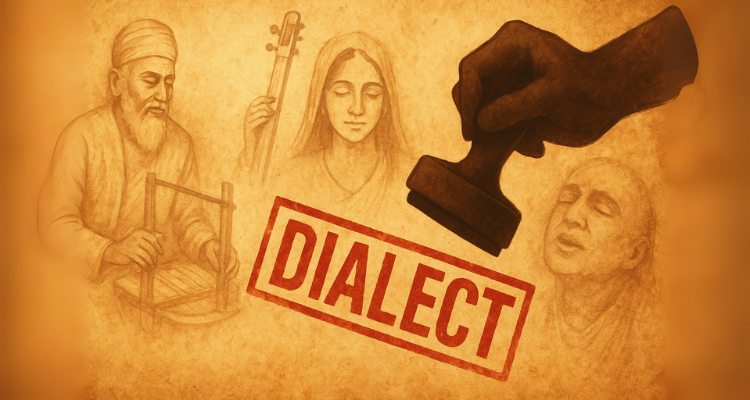
In Indian literature, words do more than tell stories sometimes, they decide which stories survive. One such word is “dialect.”
At first glance, it appears harmless, a neutral linguistic category. But, beneath it lies a subtle hierarchy, a centuries-old politics of recognition and invisibility.
Why is Bhojpuri, with nearly 50 million speakers, still called a dialect of Hindi, while languages with far fewer speakers in Europe enjoy full official status? Why did Maithili need to fight for decades before being recognized in 2003, even though its literary tradition stretches back to Vidyapati?
To call something a dialect is not merely to describe it. It is to diminish it.
Literature Beyond the Label
History shows us that literature does not respect these bureaucratic boundaries. Some of the greatest figures of Indian letters wrote in tongues their contemporaries would have dismissed as “regional” or “rustic.”
- Kabir wrote his verses in the everyday speech of his weavers.
- Surdas sang in Braj Bhasha, not in “standard” Hindi.
- Meera composed in the dialects of Rajasthan, without worrying about linguistic status.
And yet, centuries later, it is these voices, not the polished “official” registers, that remain etched in our memory. Literature seems to know something that politics does not: that the power of a story lies not in its label, but in its resonance.
The Stakes of Recognition
Still, the politics of recognition cannot be ignored. A language enshrined in the Constitution gains more than a title, it gains institutional life. It enters school curricula, receives publishing support, finds its place in examinations and employment.
A dialect, on the other hand, is confined to oral memory, folk performance, and the margins of publishing. Writers who choose it often find themselves excluded from mainstream markets. Their readership remains local, their voices unheard beyond their region.
This is not just a literary problem. It is a question of cultural survival. When a dialect is denied recognition, it risks being absorbed, flattened, or erased by a larger language that overshadows it.
The Reader’s Responsibility
It would be easy to imagine this as a battle fought in legislatures and linguistic commissions alone. But there is another battlefield: the marketplace of reading.
Readers, too, determine what survives. When we consistently choose English novels or Hindi bestsellers, we send a signal about which stories have value. When we hesitate to buy a collection of Tulu poetry or a Bhojpuri novel, we are not merely exercising taste, we are shaping the economics of recognition.
The responsibility, therefore, does not rest only with governments or academies. It rests with us, the readers, who decide daily which voices are worthy of our attention.
The truth is, the line between “language” and “dialect” is often arbitrary. Linguists know that every dialect is a complete system with grammar, idioms, and metaphors. What makes it a “language” is not structure but power: an army, a state, a recognition committee.
To deny this is to perpetuate injustice. To acknowledge it is to realize that Indian literature is far richer, more plural, and more layered than our official categories suggest.
As a student of literature, I have learned that the map of Indian writing is far richer than our official categories suggest. It is not a landscape of 22 languages neatly arranged in the Constitution. It is a chorus of hundreds of voices, some loud, some whispered, some still waiting to be heard.
Every time we call a language a dialect, we participate, knowingly or unknowingly, in this silencing. And every time we choose to read, share, and celebrate a so-called dialect, we restore dignity to a voice that deserves its place in the library of Indian literature.
To me, the question, then, is not academic. It is moral:
Will we let labels decide the worth of stories, or will we, as readers, insist that every tongue that tells a tale is a language in its own right?


Add a comment
Add a comment