
The Barefoot Storyteller
September 12, 2025
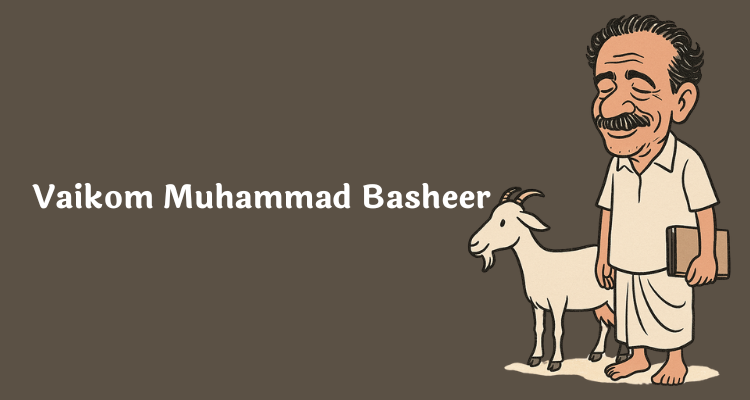
Vaikom Muhammad Basheer
- Basheer’s characters were drawn from society’s margins, gamblers, pickpockets, and prostitutes, but were depicted with innocence and humanity.
- He wrote in a colloquial, grammar-free style that brought him closer to the people and away from literary elitism.
- His barefoot wanderings, prison days, and personal struggles shaped both his worldview and storytelling.
- Basheer remains a symbol of how Malayalam literature broke away from high-brow traditions to embrace the voices of the ordinary.
As a reader of Malayalam books, there comes a moment when one stumbles upon Vaikom Muhammad Basheer and feels the ground shift beneath the feet. At first, it feels like breaking some secret literary rule. Here is a man who writes without caring much for grammar, punctuation, or the rigid rules of "proper Malayalam." And yet, his words hit deeper than many polished lines ever could.
When I first read Balyakalasakhi (Childhood Companion), it felt less like reading a novel and more like overhearing a story told under a tree, with the dust of life still on the narrator’s clothes. That was Basheer’s gift; he never sat on a pedestal. He sat among us, the readers.
A Different Kind of Character
One thing every reader notices: Basheer’s world is filled not with kings, heroes, or gods, but with gamblers, thieves, prostitutes, pickpockets, beggars, and lunatics. Yet, they are not treated with contempt or moral superiority. Instead, they are rendered innocent, naive, and achingly human.
- Premalekhanam (The Love Letter) explores the complexities of love, marriage, and societal hypocrisies through the lives of ordinary people.
- Shabdangal (Voices) deals with war, poverty, and hunger, not from a general’s view, but from the mouths of broken men.
- Pathummayude Aadu (Pathumma’s Goat), arguably one of the funniest works in Malayalam, is built around the chaos of his own family and a goat that eats up manuscripts and household essentials alike.
For me, as a reader, it was liberating to discover that literature could be about people like us, or even those we often ignore on the street. Basheer gave the marginalised a stage, and in doing so, he gave us readers a mirror to society.
His Style: Grammar? What Grammar!
Critics often accused Basheer of “spoiling” Malayalam. He didn’t bother with rigid grammar or literary refinement. He wrote the way people spoke, the raw, earthy, colloquial Malayalam of tea shops, street corners, and prison cells.
At first, I wondered: How can such writing survive in the literary world that worships form and correctness? But that was precisely the revolution.
Basheer’s language democratized literature. His stories could be read by anyone, from a farmer in Kuttanad to a rickshaw puller in Kochi. He wasn’t writing for professors; he was writing for the general public.
That’s why, even today, reading Basheer feels like being spoken to, not lectured at. And perhaps that’s why his fan base stretched far beyond the literary elite—he became “the people’s writer” in the truest sense.
Works That Defined Him
- Balyakalasakhi (1944): A tender love story of Majeed and Suhra, often considered the “Malayalam Romeo and Juliet,” yet rooted in poverty and tragedy.
- Premalekhanam (1943): A satirical take on marriage and dowry, with humorous dialogue.
- Pathummayude Aadu (1959): A hilarious semi-autobiographical account of his family.
- Shabdangal (1947): One of the first Indian novels to deal with homosexuality, war trauma, and raw human suffering—well ahead of its time.
- Janmadinam (1945): A short story that mixes wit with sharp social commentary.
Each work broke away from elitist narrative structures and instead embraced colloquial humour, satire, and human warmth.
What Makes Basheer Unique?
- The People’s Language: He showed that literary greatness doesn’t need ornate words; it requires honesty.
- Compassion for the Marginalised: He blurred the line between “sinners” and “saints.” In his stories, a thief could be more humane than a priest.
- Humour in Poverty: Even hunger and chaos became laughable in his hands.
- Ahead of His Time: His themes of mental illness, sexuality, class struggle, and existential despair predated global literary shifts.
As a reader, what amazes me most is that Basheer could make me laugh until my stomach hurt (Pathumma’s Goat) and then make me weep in the same breath (Balyakalasakhi). That rare balance of humour and tragedy is what makes his stories unforgettable.
Whenever I revisit Basheer, I am struck by how modern he feels. He proved that even the so-called “unimportant” people matter in stories, and therefore, in life.
His questioning of societal norms, his rejection of elitism, his humour in the face of despair, everything... all resonates with today’s readers. In an era when literature sometimes feels too abstract or pretentious, Basheer remains fresh and relatable.
For me as a reader, finding Basheer was like seeing an old friend who tells stories not from a stage, but from the same bench I am sitting on.
As long as readers search for authenticity, Basheer will remain alive, not just as a writer but as a companion, whispering simple, barefoot truths into our ears.


Add a comment
Add a comment